

How scientific evidence supports supplement choices after 50
TL;DR:
- Supplement regulation and evidence standards vary between the US and EU, affecting claim credibility.
- High-quality evidence like RCTs specific to older adults is essential for trustworthy supplement claims.
- For healthy ageing, focus on vitamin D, B12, omega-3, magnesium, and calcium, ideally from food sources.
Supplements line the shelves with promises of sharper memory, stronger bones, and better energy. For adults over 50, the stakes of choosing wisely are real. Yet the phrase “science-backed” is used so broadly that it has lost much of its meaning. Regulatory standards differ by country, study quality varies enormously, and what works in a 30-year-old may not apply to you. Understanding how evidence is generated and assessed is not just academic; it directly shapes whether a supplement is worth your money or your trust.
Table of Contents
- How supplements are regulated and why evidence matters
- What counts as ‘scientific evidence’ for supplements?
- Common gaps and challenges in supplement research
- How to use scientific evidence to choose supplements for healthy ageing
- Why ‘evidence-based’ doesn’t always mean effective for you
- Explore evidence-based supplement guides
- Frequently asked questions
Key Takeaways
| Point | Details |
|---|---|
| Regulation gaps | Supplements are not regulated as strictly as medicines, so claims may not be pre-approved. |
| Evidence varies | Quality of evidence behind supplement claims is uneven, often based on small or non-human studies. |
| Best use cases | Supplements are most useful for correcting proven deficiencies, not for routine use by healthy adults. |
| Be sceptical | Demand evidence from high-quality human studies and consult healthcare professionals before starting new supplements. |
| Food first | A balanced diet remains the gold standard for nutrient intake for adults over 50. |
How supplements are regulated and why evidence matters
The rules governing supplements are not the same everywhere, and the gap between regions has a direct effect on what evidence manufacturers must provide. In the United States, the Dietary Supplement Health and Education Act of 1994 (DSHEA) set the framework still used today. Under this legislation, supplements are regulated more like food than medicine, meaning companies do not need pre-market approval to prove their products work. The burden falls on the Food and Drug Administration (FDA) to demonstrate harm after a product is already on sale.
The European Union takes a stricter approach. The European Food Safety Authority (EFSA) reviews health claims before they can appear on product packaging. EFSA dossier approvals require documented scientific substantiation, which raises the bar considerably.
“A manufacturer of a dietary supplement does not have to provide FDA with evidence that the product is safe or effective before marketing.” This DSHEA principle means that products sold in the US market may carry health claims without the same scrutiny applied elsewhere.
Key requirements for making claims in either region:
- The claim must not say the supplement treats or cures a disease
- In the US, structure/function claims (e.g., “supports joint health”) must be notified to the FDA within 30 days of going to market
- In the EU, only claims on the approved EFSA list may appear on labels
- In both regions, manufacturers are responsible for product safety and accuracy
| Feature | United States (FDA/DSHEA) | European Union (EFSA) |
|---|---|---|
| Pre-market approval required | No | Yes, for health claims |
| Evidence standard | Reasonable basis | Scientific consensus |
| Enforcement | Reactive (post-market) | Proactive (pre-market) |
| Health claim oversight | Structure/function allowed | Only EFSA-approved claims |
For you as a consumer, these differences matter practically. A product sold legally in one region with a specific health claim may not meet the evidence threshold required elsewhere. Checking where a product was assessed and under which rules is a useful first step. For broader guidance, supplement safety tips offer a solid starting point.
What counts as ‘scientific evidence’ for supplements?
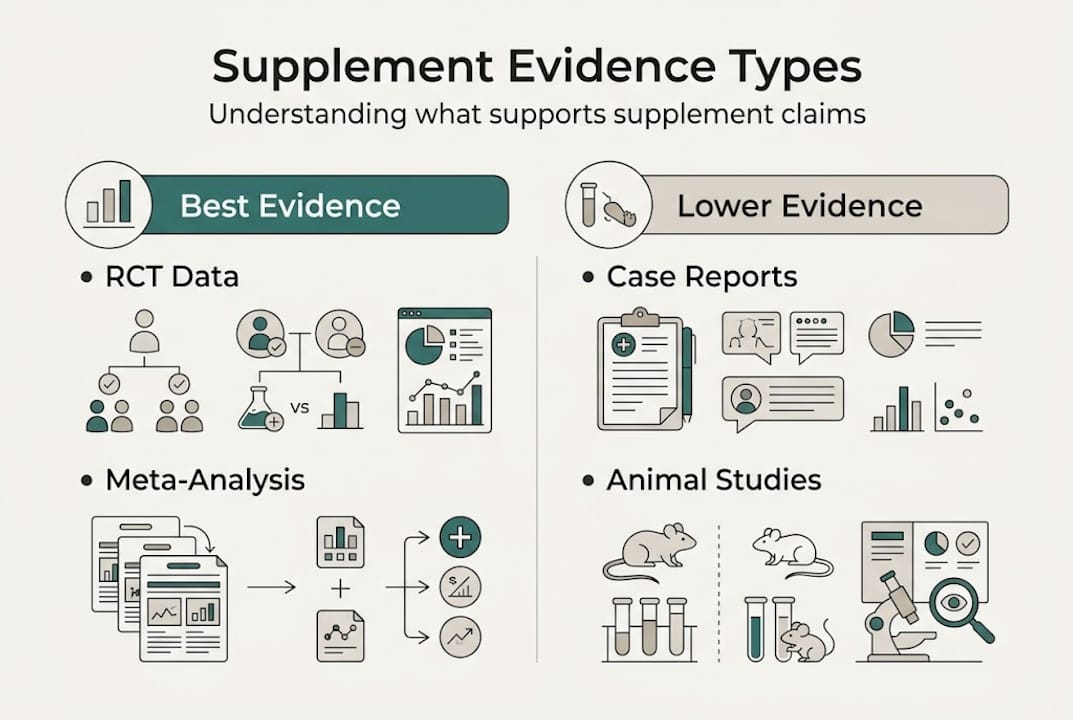
Not all evidence is equal. A single study showing a supplement improved cholesterol in 40 healthy men tells you very little about whether it will work for a 65-year-old woman managing several health conditions. Understanding the hierarchy of evidence helps you ask the right questions.
Types of scientific evidence and their strength:
| Evidence type | Description | Reliability for supplement claims |
|---|---|---|
| Randomised controlled trial (RCT) | Participants randomly assigned to supplement or placebo | Highest (gold standard) |
| Cohort study | Large groups followed over time | Moderate |
| Case-control study | Compares people with and without an outcome | Moderate to low |
| Animal or in vitro research | Lab-based, not in humans | Lowest for human application |
Structure/function claims must be supported by reliable scientific evidence, but the FDA does not evaluate these claims before they reach the market. This means a product can legally carry a claim without ever being tested in a clinical trial with older adults.
Steps from research to a claim on a supplement bottle:
- A scientist or manufacturer identifies a potential benefit, often from animal or cell studies
- Small human studies (sometimes called pilot trials) are conducted
- Results are published, sometimes in journals with varying levels of peer review
- The manufacturer uses these findings to draft a health claim
- In the US, the claim is submitted to the FDA for notification only; in the EU, it is submitted for approval
- The product reaches shelves, often long before large-scale trials are completed
The critical issue for adults over 50 is that many trials use younger populations. An RCT conducted in adults aged 25 to 45 cannot reliably predict outcomes in older adults with different absorption rates, medication use, and baseline nutritional status. A trial in younger adults is not irrelevant, but it should not be the only evidence you rely on.
Pro Tip: When reviewing supplement claims, search for RCTs that specifically recruited participants aged 50 and above. If none exist for a product, consider that a significant gap in the evidence.
For a clearer picture of using supplements safely and which products have meaningful backing, look specifically for studies matching your age group and health goal. Evidence-backed supplements for ageing can help narrow down those options further.
Common gaps and challenges in supplement research
Even when studies exist, they often fall short in ways that are rarely mentioned on product labels. Evidence for many supplements is weak or ambiguous, shaped by small study sizes, variable product formulations, and results that directly contradict each other.
The most common research shortfalls include:
- Small sample sizes that lack the statistical power to detect real effects
- Short study durations that miss long-term outcomes
- Inconsistent formulations: for example, ashwagandha tested as root extract in one study and whole plant powder in another
- Lack of standardisation for dose and bioavailability
- Under-representation of adults over 60, particularly those with chronic conditions
Clinical trials on supplements are frequently limited by short durations and standardisation problems, which makes drawing firm conclusions difficult even when results appear positive.
A high-profile 2019 study suggested vitamin E supplementation could reduce cognitive decline, but subsequent larger trials found no benefit and even flagged potential risk at high doses. This kind of reversal is common in supplement research, and it illustrates why single studies should not drive purchasing decisions.
For older adults, the problem is compounded. Many studies either exclude participants over 65 entirely or use doses that are too low to reflect realistic use. There is also the question of product purity. Without mandatory pre-market testing, some products contain contaminants or lower-than-stated active ingredient levels.

Pro Tip: If you are considering a new supplement, request blood tests to establish your baseline levels first. Choose products certified by independent bodies such as USP (United States Pharmacopeia) or NSF International to reduce contamination risk. For further context, nutritional supplements for ageing covers quality markers worth checking.
How to use scientific evidence to choose supplements for healthy ageing
With a realistic view of what the research can and cannot tell you, a practical approach becomes straightforward.
Steps to decide whether you need a supplement:
- Identify whether you have a confirmed deficiency through a blood test or clinical assessment
- Check whether a supplement for that deficiency has RCT evidence in adults over 50
- Review the dose used in trials and compare it to what the product offers
- Consult your GP or a registered dietitian, particularly if you take prescription medications
- Set a review period of three to six months to assess whether you notice any measurable change
The best-supported supplements for adults over 50:
- Vitamin D: Bone health, immune function, and mood; particularly relevant if you live in a low-sunlight region
- Vitamin B12: Nerve function and energy metabolism; absorption declines with age, making supplementation often warranted
- Omega-3 fatty acids: Heart health and cognitive function; best supported when dietary fish intake is low
- Magnesium: Muscle function and sleep quality; often low in older adults with restricted diets
- Calcium: Bone density; best taken with vitamin D and ideally from dietary sources where possible
Omega-3, vitamin D, and CoQ10 have some supporting evidence for adults over 50, though food sources remain preferable where achievable. Supplements are best reserved for those with confirmed deficiencies; a balanced diet should take priority.
Red flags to watch for on supplement labels:
- Claims that sound like medical treatments (“reverses ageing”, “cures inflammation”)
- No mention of the dose used in supporting studies
- References only to animal or in vitro research
- No independent third-party certification
Review your supplement use annually. New research emerges regularly, and what appeared well-supported in 2022 may look different by 2026. Explore top evidence-backed nutritional products and the best vitamins for ageing adults for updated guidance.
Why ‘evidence-based’ doesn’t always mean effective for you
The label “evidence-based” has become a marketing tool as much as a scientific standard. Understanding its limits protects you from poor decisions.
Industry supports using the totality of evidence, including non-human studies and observational data, while regulators and clinical bodies generally insist on RCTs conducted in humans. This disagreement is not merely technical; it means that a supplement can be credibly described as “evidence-based” by its manufacturer while failing to meet the threshold that a GP or nutritionist would apply.
Your personal circumstances add another layer. A supplement with strong trial data in healthy older adults may not apply to you if you have kidney disease, take blood-thinning medication, or have specific absorption issues. Population-level evidence is a starting point, not a prescription. Sometimes, the most evidence-based decision you can make is to take no supplement at all, and instead address the diet or lifestyle factor that created the shortfall. This is rarely the conclusion that supplement marketing leads you towards, which is precisely why it is worth stating clearly.
Explore evidence-based supplement guides
Choosing supplements wisely after 50 requires more than reading a label. The science matters, the regulatory context matters, and your individual health status matters.
At Vivetus, the focus is on resources and products informed by current research, so you can make decisions grounded in real evidence rather than marketing claims. Whether you are new to supplementation or reviewing what you already take, the graceful ageing supplement guide offers structured, science-led information to help you prioritise what genuinely supports healthy ageing. Explore it as a practical companion to the evidence principles outlined here.
Frequently asked questions
How can I tell if a supplement’s claims are truly science-backed?
Structure/function claims must be supported by reliable scientific evidence, but they are not pre-evaluated by regulators. Look for human RCTs in adults over 50 and independent certification from bodies such as USP or NSF.
Which supplements have the strongest evidence for adults over 50?
Vitamin D, B12, and omega-3 are best supported for older adults, particularly where a confirmed deficiency exists, covering bone health, nerve function, and cardiovascular support respectively.
Is it better to get nutrients from food or supplements?
Nutrients from food are generally better absorbed and come with additional dietary benefits. Supplements are best used when a specific deficiency has been confirmed through testing rather than as a general preventive measure.
Are supplement risks higher for older adults?
Yes. Age-related changes in metabolism, combined with a higher likelihood of medication use, increase the risk of interactions and side effects. Supplements can carry risks including drug interactions and contamination, so always discuss new additions with your GP.
Why are supplement studies often contradictory?
Many supplement studies use small sample sizes, differing formulations, and short durations, which produces inconsistent results. Without standardised ingredients and adequate participant numbers, even well-intentioned trials can point in opposite directions.