
Understanding the meaning of longevity for healthier, vibrant living
Most people think longevity simply means living to 100, but that’s only half the story. True longevity isn’t about adding years to your life; it’s about adding life to your years. Healthspan, the period you spend in good health with full physical and mental function, matters far more than lifespan alone. This article explores what longevity really means, the biological mechanisms driving ageing, and the nutritional strategies proven to enhance vitality and support graceful ageing. You’ll discover practical ways to optimise your healthspan through evidence-based dietary choices and lifestyle modifications.
Table of Contents
- Key takeaways
- What does longevity really mean?
- The biological processes behind ageing and longevity
- Nutritional strategies proven to support longevity and vitality
- Lessons from centenarians and practical applications for aging gracefully
- Enhance your longevity journey with Vivetus® solutions
- Frequently asked questions
Key Takeaways
| Point | Details |
|---|---|
| Healthspan over lifespan | The goal of longevity is to extend the years lived in good health rather than merely increasing total years. |
| Aging biology | A range of processes such as cellular damage, senescence, telomere shortening, mitochondrial decline and chronic inflammation drive ageing and influence healthspan. |
| Dietary patterns boost longevity | Intermittent fasting and other evidence based dietary choices activate longevity pathways and support healthy ageing. |
| Practical lifestyle choices | Practical nutrition and lifestyle choices can extend healthspan by maintaining independence, cognitive function and physical vitality. |
What does longevity really mean?
Longevity encompasses more than simply counting birthdays. Longevity primarily refers to long duration of life or lifespan, but in health contexts emphasises healthspan, the years lived in good health with preserved physical, mental, and social function. This distinction transforms how we approach ageing.
Healthspan represents the period during which you maintain independence, cognitive sharpness, physical mobility, and meaningful social connections. You might live to 95, but if the final 15 years involve chronic disease, disability, and dependence, your healthspan ended at 80. The World Health Organisation defines healthy ageing as developing and maintaining functional ability that enables wellbeing in older age, emphasising capacity over mere survival.
The rising number of centenarians globally highlights a concerning trend: many reach 100 whilst managing multiple chronic conditions and taking numerous medications. This phenomenon, called the morbidity burden, demonstrates that lifespan extension without healthspan preservation creates more suffering than benefit. Modern longevity science focuses on compressing morbidity, pushing disease onset closer to the end of life whilst extending the years of robust health.
Key aspects of meaningful longevity include:
- Physical vitality allowing independent movement and daily activities
- Cognitive function preserving memory, learning, and decision-making
- Metabolic health maintaining stable glucose, inflammation markers, and body composition
- Social engagement supporting relationships and community participation
- Psychological resilience enabling adaptation and emotional wellbeing
Understanding longevity through the healthspan lens shifts your focus from simply avoiding death to actively cultivating wellness. The longevity core bundle approach recognises this distinction, targeting biological processes that preserve function rather than merely extending survival.
Having defined longevity clearly, we can now examine the biological processes driving ageing.
The biological processes behind ageing and longevity
Ageing unfolds through interconnected molecular and cellular mechanisms that gradually diminish your body’s ability to maintain homeostasis and repair damage. Biological mechanisms of ageing include accumulation of molecular and cellular damage, senescence, telomere shortening, mitochondrial dysfunction, chronic inflammation, and dysregulation of nutrient-sensing pathways like mTOR, IGF-1, AMPK, and sirtuins. These processes determine both lifespan and healthspan.

Cellular senescence occurs when cells stop dividing but don’t die, instead secreting inflammatory molecules that damage surrounding tissues. These “zombie cells” accumulate with age, contributing to tissue dysfunction and chronic disease. Telomeres, protective caps on chromosome ends, shorten with each cell division until cells can no longer replicate properly. Whilst telomere length correlates with biological age, it’s one marker among many rather than the sole determinant.
Mitochondria, your cells’ energy factories, become less efficient over time. Damaged mitochondria produce excessive reactive oxygen species whilst generating less ATP, the cellular energy currency. This mitochondrial dysfunction impairs tissue function and accelerates ageing across organ systems. Chronic low-grade inflammation, termed inflammaging, creates a pro-ageing environment that promotes disease development.
Nutrient-sensing pathways act as master regulators of ageing:
- mTOR (mechanistic target of rapamycin) promotes growth and protein synthesis; excessive activation accelerates ageing
- IGF-1 (insulin-like growth factor 1) drives cell proliferation; elevated levels correlate with faster ageing
- AMPK (AMP-activated protein kinase) responds to energy stress; activation promotes longevity
- Sirtuins regulate DNA repair and metabolism; activation extends healthspan in multiple species
These pathways respond to nutritional inputs, exercise, and other environmental factors. Caloric restriction, for instance, reduces mTOR and IGF-1 activity whilst activating AMPK and sirtuins, creating a pro-longevity cellular environment. Understanding ageing process science helps you recognise why specific interventions work at the molecular level.
Pro Tip: Understanding these pathways can guide targeted nutritional choices. For example, periodic protein restriction specifically modulates mTOR, whilst plant polyphenols activate sirtuins, allowing you to address multiple ageing mechanisms simultaneously through diet.
With the biological basis understood, let’s explore how nutrition influences these ageing processes.
Nutritional strategies proven to support longevity and vitality
Nutrition represents your most powerful tool for influencing ageing biology. Nutritional methodologies for longevity include caloric restriction, intermittent fasting, low-protein and high-legume diets, and plant-predominant diets that activate autophagy whilst reducing mTOR and IGF-1 activity. These approaches don’t require extreme measures; modest, consistent application delivers significant benefits.
Caloric restriction, reducing intake by 10 to 30% without malnutrition, extends lifespan in numerous species by triggering cellular stress responses that enhance repair mechanisms. Human studies show improved metabolic markers, reduced inflammation, and better cardiovascular health. However, severe restriction risks nutrient deficiency and reduced quality of life, making moderate approaches more practical.
Intermittent fasting offers similar benefits with greater flexibility. Time-restricted eating, consuming all meals within an 8 to 10 hour window, or alternate-day modified fasting both activate autophagy, your cellular recycling system that clears damaged components. Research suggests intermittent fasting can add approximately two years to healthy life expectancy whilst improving insulin sensitivity and reducing oxidative stress.
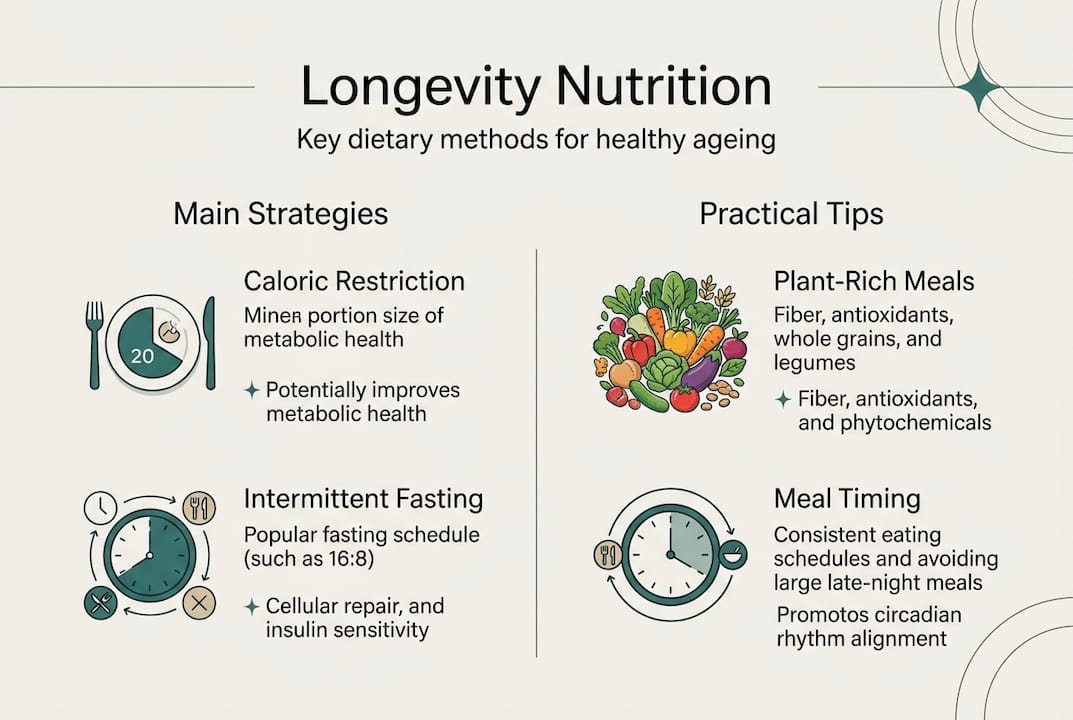
Plant-predominant dietary patterns consistently associate with longevity across populations. Mediterranean, Okinawan, and other traditional diets share common features: abundant vegetables, fruits, whole grains, legumes, nuts, and seeds with minimal processed foods and moderate animal protein. These patterns provide fibre, polyphenols, and phytonutrients that support gut microbiome diversity and reduce systemic inflammation.
Evidence-based nutritional strategies for longevity:
- Practice time-restricted eating, finishing meals by early evening to maximize overnight fasting
- Emphasize plant proteins from legumes, maintaining moderate total protein intake
- Include cruciferous vegetables daily for sulforaphane and other protective compounds
- Consume omega-3 fatty acids from fatty fish, walnuts, or algae sources
- Limit refined carbohydrates and added sugars that spike insulin and promote inflammation
- Incorporate periodic protein cycling, reducing intake 1 to 2 days weekly
| Dietary approach | Primary mechanism | Practical application |
|---|---|---|
| Caloric restriction | Activates AMPK, reduces mTOR | Reduce portions 10-20%, focus on nutrient density |
| Intermittent fasting | Triggers autophagy, improves metabolic flexibility | 16:8 time restriction or 5:2 modified fasting |
| Plant-predominant diet | Provides polyphenols, reduces inflammation | Fill half your plate with vegetables, emphasize legumes |
| Protein moderation | Lowers IGF-1, balances mTOR activity | 0.8-1.0g per kg body weight, cycling lower periodically |
Pro Tip: After age 65, transition protein intake strategy. Whilst moderate protein supports longevity in midlife, older adults need adequate protein to preserve muscle mass. Aim for 1.0 to 1.2g per kilogram body weight, distributed across meals, to balance longevity pathways with sarcopenia prevention.
Exploring supplements for healthy aging can complement these dietary foundations by addressing specific nutritional gaps that emerge with age.
Armed with nutritional knowledge, we now consider empirical data and what centenarians reveal about longevity.
Lessons from centenarians and practical applications for aging gracefully
Centenarian populations provide real-world evidence of longevity principles in action. Centenarians show plant-rich diets and moderate calories; data reveals rising morbidity and polypharmacy; biomarkers linked to longevity include intermediate ferritin and low glucose. These observations offer practical guidance whilst highlighting challenges that pure lifespan extension creates.
Blue Zones, regions with exceptional centenarian concentrations, share dietary and lifestyle patterns. Okinawans traditionally consumed 80% of caloric needs, emphasizing sweet potatoes, vegetables, and soy products. Sardinians eat pecorino cheese, fava beans, and sourdough bread whilst maintaining active shepherding lifestyles. Seventh-day Adventists in Loma Linda follow plant-based diets with strong community bonds. These populations move naturally throughout the day, maintain purpose, and prioritize social connections.
However, modern centenarian studies reveal concerning trends. Many individuals reaching 100 manage multiple chronic conditions, take numerous medications, and experience significant functional limitations. This morbidity burden demonstrates that reaching extreme age doesn’t guarantee quality of life. The goal isn’t simply living longer; it’s compressing the period of disability into the final months rather than final decades.
| Health marker | Typical centenarians | General ageing population |
|---|---|---|
| Fasting glucose | 4.5-5.0 mmol/L | 5.5-6.5 mmol/L |
| Ferritin levels | Intermediate range (100-200 μg/L) | Often elevated or depleted |
| Inflammatory markers | Lower CRP and IL-6 | Elevated inflammatory profile |
| Medication count | Often 3-5+ daily | 2-3 in 60s, increasing with age |
| Functional independence | Variable, many need assistance | Declines progressively from 70s |
Biomarker patterns in successful agers emphasise metabolic health. Lower glucose levels throughout life correlate with longevity, whilst intermediate ferritin suggests balanced iron status without deficiency or excess. Chronic inflammation markers remain lower in those maintaining function into advanced age.
Practical applications from centenarian research:
- Maintain consistent meal timing and avoid late-night eating
- Build physical activity into daily routines rather than relying solely on structured exercise
- Cultivate strong social networks and community involvement
- Find purpose and meaning that motivates engagement with life
- Manage stress through social connection, nature exposure, and mindfulness practices
- Prioritise sleep quality and duration for cellular repair processes
The NMN supplement study demonstrates how targeted nutritional support can complement lifestyle factors by addressing age-related metabolic changes.
Recognising challenges and practical steps leads us to how you can start enhancing your own healthspan today.
Enhance your longevity journey with Vivetus® solutions
Applying longevity science requires more than knowledge; it demands consistent nutritional support tailored to your body’s changing needs. Vivetus® offers targeted supplements designed to support the biological pathways discussed throughout this article, helping you translate research into daily practice.
The methylation and energy support provided by Vivetus® TMG addresses fundamental cellular processes that decline with age. Combined with comprehensive formulations in the energy & vitality bundle, you gain tools to enhance daily wellness whilst supporting long-term healthspan goals.
These solutions complement the dietary patterns and lifestyle strategies explored here, providing concentrated nutritional support where diet alone may fall short. Explore how Vivetus® products can personalize your longevity approach, bridging the gap between scientific understanding and practical application.
Frequently asked questions
What is the difference between lifespan and healthspan?
Lifespan measures total years lived from birth to death, while healthspan counts only the years spent in good health with preserved physical, mental, and social function. You could live to 90 but experience poor healthspan if chronic disease and disability dominate your final decades. Longevity science prioritizes extending healthspan, compressing illness into the briefest period possible rather than simply adding years to life.
How does intermittent fasting contribute to longevity?
Intermittent fasting activates autophagy, your cellular recycling system that clears damaged proteins and organelles, while reducing chronic inflammation and improving metabolic flexibility. These mechanisms enhance cellular repair and stress resistance. Research indicates that consistent intermittent fasting practices can add approximately two years to healthy life expectancy, with benefits including improved insulin sensitivity, reduced oxidative stress, and better cardiovascular markers.
Are radical life-extending treatments currently effective?
Radical interventions like extreme caloric restriction, experimental pharmaceuticals, or intensive supplement protocols remain scientifically uncertain with unclear risk-benefit profiles. While some individuals pursue aggressive approaches, current evidence supports moderate, sustainable lifestyle and nutritional strategies as the most reliable path to longevity gains. Bryan Johnson’s longevity experiments illustrate both the potential and limitations of extreme protocols, highlighting that balanced approaches often deliver better adherence and outcomes.
What simple lifestyle changes support a longer, healthier life?
Adopt a plant-predominant diet rich in vegetables, legumes, whole grains, and healthy fats while moderating protein intake to 0.8 to 1.0g per kilogram body weight. Practice time-restricted eating by consuming meals within an 8 to 10 hour window and finishing by early evening. Maintain regular physical activity through both structured exercise and natural daily movement. Cultivate strong social connections and find meaningful purpose that keeps you engaged with life and community.