

Supplement synergy: boost vitality and longevity in 2026
TL;DR:
- Genuine supplement synergy occurs when specific combinations produce effects greater than individual nutrients.
- Evidence-backed pairs like Vitamin D with Magnesium or Curcumin with Piperine enhance health benefits effectively.
- Avoid combining minerals like iron and calcium simultaneously to prevent absorption interference.
Taking more supplements does not automatically mean better results. Many adults over 35 fall into the trap of stacking products without understanding how nutrients interact. True supplement synergy occurs when specific combinations amplify each other’s effects in ways that neither could achieve alone. Synergy rooted in nutrition science dates back to the early 20th century, when researchers first observed that whole foods delivered benefits no single isolated nutrient could replicate. This guide cuts through the noise, debunks the “more is better” myth, and gives you a clear, evidence-based framework for using supplement synergy to support your vitality and long-term health.
Table of Contents
- Understanding supplement synergy: What it really means
- The science behind synergy: Evidence from research
- Common synergistic pairs and pitfalls for adults over 35
- Applying supplement synergy: Safe strategies and expert tips
- Beyond the hype: What most guides miss about supplement synergy
- Enhance your vitality with trusted synergistic supplements
- Frequently asked questions
Key Takeaways
| Point | Details |
|---|---|
| Synergy amplifies benefits | Pairing specific supplements boosts their effectiveness thanks to strategic scientific mechanisms. |
| Not all pairs work | Some supplement combinations compete or reduce absorption, so evidence-based choices are essential. |
| Safety and evidence-first | Always prioritise proven pairs, whole-food synergy, and professional guidance for complex combinations. |
| Individual response matters | Synergistic effects can vary by person, so monitoring and guidance is key for optimal results. |
Understanding supplement synergy: What it really means
Supplement synergy is not simply about combining two or more products. It refers to a measurable, scientifically documented interaction where the combined effect exceeds what each ingredient produces on its own. This is distinct from an additive effect, where two nutrients simply contribute their individual benefits side by side without influencing each other.
Understanding the mechanisms behind synergy helps you make smarter choices. Researchers identify three primary categories of interaction:
- Physicochemical interactions: These occur before absorption, when nutrients in the gut influence each other’s solubility or stability.
- Pharmacokinetic interactions: These affect how nutrients are absorbed, distributed, metabolised, or excreted. One nutrient may improve the bioavailability of another.
- Pharmacodynamic interactions: These occur when nutrients target the same or different pathways in the body, producing a combined effect that is greater than the sum of its parts.
Not every combination falls into the synergistic category. Some nutrients compete directly for the same absorption receptors. Others may neutralise each other’s activity entirely. This is why the concept of synergy must be rooted in evidence rather than assumption.
“Whole foods naturally provide synergistic nutrient effects that supplements must work hard to replicate. The complexity of food matrices is still not fully understood.” — Nutrition science consensus
For adults focused on healthy ageing, this distinction matters enormously. You may already be taking several supplements daily. The question is not how many you are taking, but whether the combinations you have chosen are genuinely working together. Reviewing evidence-backed supplement pairs is a practical starting point for making that assessment.
Synergy also depends on timing, dose, and formulation. Two nutrients that work synergistically at moderate doses may not produce the same effect at very high or very low doses. The science is precise, and that precision is what separates effective supplementation from guesswork.
The science behind synergy: Evidence from research
Empirical research on supplement synergy has grown substantially over the past decade. Some of the most compelling data comes from studies on multi-ingredient blends, where the combined formula consistently outperforms individual components tested in isolation.
One area with strong data is multi-ingredient pre-workout supplements (MIPS). A peer-reviewed study found that MIPS improved anaerobic power output to 10.7 to 10.8 W/kg compared to 10.4 W/kg in the placebo group, alongside improvements in VO2 peak. The same research highlighted that plant-based combinations such as capsaicin and menthol reduced inflammation markers by as much as 699-fold. These are not marginal gains.
| Supplement combination | Measured benefit | Effect vs placebo |
|---|---|---|
| MIPS blend | Anaerobic power | +0.3 to 0.4 W/kg |
| Capsaicin + menthol | Inflammation markers | Up to 699-fold reduction |
| Vitamin D + Magnesium | Bone mineral density | Significantly improved |
| Omega-3 + Vitamin E | Oxidative stress | Reduced synergistically |
These results are significant for adults over 35, where maintaining muscle power, cardiovascular endurance, and managing inflammation are central to long-term vitality. The data shows that when formulations are designed with synergy in mind, the results are measurable and clinically meaningful.

However, not every combination delivers. Research consistently shows that randomly pairing supplements without a mechanistic rationale rarely produces synergistic outcomes. Some pairings are simply additive. Others may even be counterproductive. For those focused on cognitive health supplement synergy, the same principle applies: evidence-backed combinations outperform speculative stacking every time.
Understanding the advantages of nutritional supplements requires looking at the full picture, including what the research actually supports and where the gaps remain.
Common synergistic pairs and pitfalls for adults over 35
For adults prioritising bone health, cardiovascular function, and reduced inflammation, certain supplement pairings have strong scientific support. Others are worth avoiding entirely.
Pairs with solid evidence:
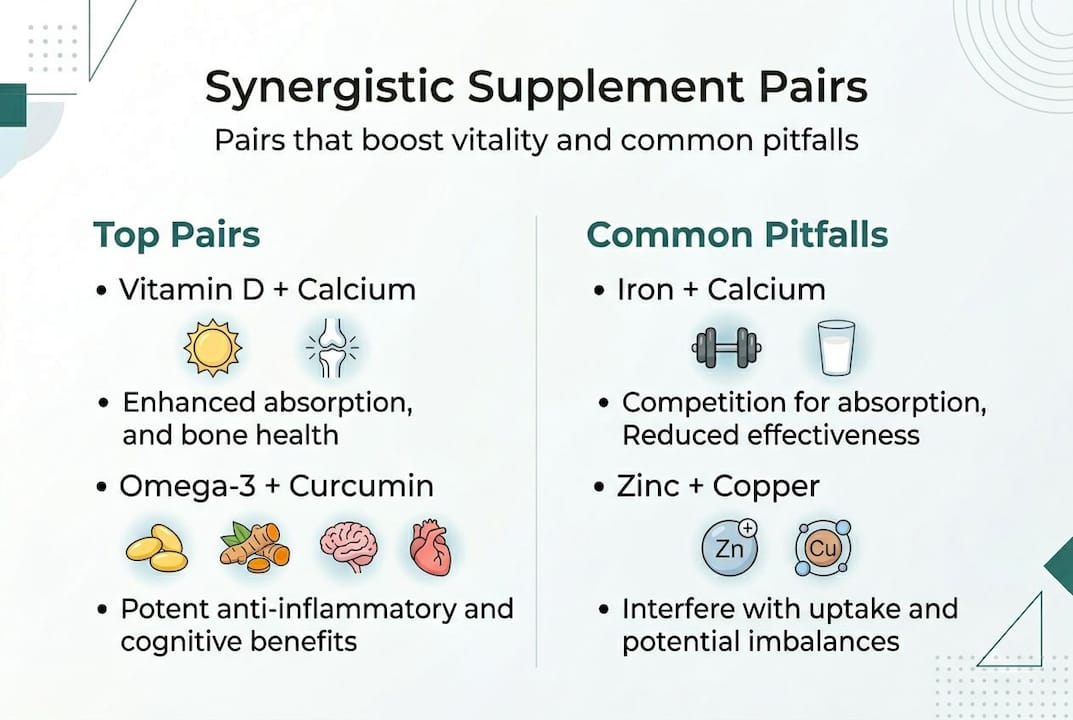
- Vitamin D + Calcium + Magnesium: This trio supports bone density and muscle function. Magnesium is essential for activating Vitamin D, making the combination far more effective than Calcium alone.
- Omega-3 fatty acids + Vitamin E: Omega-3s are susceptible to oxidation. Vitamin E acts as an antioxidant, protecting the fatty acids and extending their anti-inflammatory activity in the body.
- Vitamin C + Iron: Vitamin C significantly enhances non-haem iron absorption, making this pairing useful for those with low iron levels.
- Curcumin + Piperine: Piperine from black pepper improves curcumin bioavailability by up to 2,000%, a well-documented example of pharmacokinetic synergy.
Pairs to avoid or space out:
Not all combinations are safe or effective. Minerals like iron and calcium compete for the same absorption pathways. Taking them together reduces the uptake of both, particularly iron. High-dose calcium supplementation is especially problematic in this regard.
| Pair | Issue | Recommendation |
|---|---|---|
| Iron + Calcium | Compete for absorption | Space by at least 2 hours |
| Zinc + Copper | Zinc depletes copper | Balance doses carefully |
| Fat-soluble vitamins in excess | Accumulate in tissue | Avoid megadosing A, D, E, K |
Pro Tip: Space out competing minerals by at least two hours. Take iron in the morning and calcium in the evening to preserve the absorption of both. Always consult a healthcare professional before combining supplements, particularly if you are managing a health condition or taking prescription medication.
For a structured approach to choosing supplements for healthy ageing, evidence and individual health context should always guide your decisions.
Applying supplement synergy: Safe strategies and expert tips
Knowing which pairs work is only part of the process. Applying synergy safely and consistently requires a structured approach.
- Start with diet. Whole foods provide naturally occurring synergistic nutrient matrices that supplements cannot fully replicate. Careful formulation is required to mimic these effects, and the research is still developing. Build your nutritional foundation with food first.
- Select proven pairs. Prioritise combinations with peer-reviewed support. Avoid choosing pairings based solely on marketing claims or anecdotal reports.
- Space conflicting minerals. As noted, iron and calcium should not be taken simultaneously. Review your full supplement schedule and identify any potential conflicts.
- Check bioavailability. Some nutrients require a specific form to be absorbed effectively. Magnesium glycinate, for example, is better absorbed than magnesium oxide. The form matters as much as the dose.
- Consult a professional. Complex combinations, particularly for those managing chronic conditions, warrant professional guidance. A registered dietitian or GP can review your regimen for interactions.
- Validate claims critically. Network pharmacology is an emerging method for validating whether multi-ingredient combinations are truly synergistic or simply additive. When evaluating a supplement blend, look for brands that reference this level of scientific rigour.
Pro Tip: Keep a simple supplement log for four to six weeks when introducing a new combination. Note energy levels, sleep quality, and any physical changes. This gives you real-world data to assess whether the pairing is working for your body.
Reading supplement user reviews alongside clinical research gives a more complete picture of how combinations perform across different individuals.
Beyond the hype: What most guides miss about supplement synergy
Most articles on supplement synergy focus on listing popular pairs without addressing the deeper issue: the gap between theoretical synergy and real-world outcomes. A nutrient combination may demonstrate synergy in a controlled laboratory setting but produce far more modest results in everyday use, where diet, lifestyle, gut health, and genetics all influence absorption and response.
The whole-food synergy principle is instructive here. Nature has spent millions of years developing nutrient combinations in food that work together seamlessly. Supplements are, at best, an approximation. Quality formulation matters enormously. A poorly manufactured product with low-grade ingredients will not deliver synergistic benefits regardless of what the label claims.
Individual response is also under-reported. Two people taking the same combination may experience meaningfully different outcomes based on their microbiome, absorption capacity, and baseline nutrient status. This is not a reason to avoid supplementation. It is a reason to approach it with precision rather than optimism.
Focus on the advantages of nutritional supplements that are grounded in evidence, not on the volume of products you take. Quality, formulation, and strategic pairing will always outperform quantity.
Enhance your vitality with trusted synergistic supplements
Applying supplement synergy effectively starts with access to products formulated with scientific rigour. Vivetus offers a curated range of supplements designed specifically for adults aged 35 and over, with a focus on evidence-backed combinations that support energy, bone health, and longevity.

Explore the energy and vitality bundle to access a synergistic combination designed for sustained energy and healthy ageing. Whether you are starting out or refining an existing routine, Vivetus health solutions provide the quality and transparency you need to supplement with confidence. Free shipping is available on orders over €50.
Frequently asked questions
Can supplement synergy really improve vitality and longevity?
Yes. Evidence-backed pairs like Vitamin D, Magnesium, and Calcium support bone density and longevity, while Omega-3 and Vitamin E work together to reduce inflammation, but only when used strategically and at appropriate doses.
Are all supplement combinations safe and synergistic?
No. Some combinations actively compete for absorption. Iron and calcium, for example, reduce each other’s uptake when taken together, so spacing and professional guidance are essential.
How can I apply supplement synergy in my daily routine?
Begin with proven pairs, space out competing minerals, verify the scientific basis for each combination, and consult a healthcare professional. Careful formulation is key to replicating whole-food synergy effects.
Is supplement synergy better than whole-food nutrition?
Whole foods naturally provide synergies that supplements work to replicate. Supplements are a valuable addition to a balanced diet, not a replacement for one.