

Supplement safety: 5 steps for better health in 2026
TL;DR:
- Supplements can be contaminated, mislabeled, or cause harmful drug interactions.
- Use third-party verified products and consult healthcare providers before starting supplements.
- A healthy lifestyle and balanced diet are more important than relying solely on supplements.
Millions of adults take dietary supplements every day, hoping to support energy, immunity, and long-term vitality. Yet supplements can contain contaminants or interact with medicines in ways that cause genuine harm. The risks are not theoretical. From heavy metal contamination to dangerous drug interactions, the gap between a helpful supplement and a harmful one is often narrower than people expect. This guide walks you through the practical steps to choose, use, and monitor supplements safely, so you can support your health with confidence rather than guesswork.
Table of Contents
- Why supplement safety matters for your health
- What you need before choosing a supplement
- How to select and use supplements safely
- How to assess supplement effectiveness and stay safe
- The real key to longevity: Why smart supplement use is not enough
- Find reliable supplement guidance and quality at Vivetus®
- Frequently asked questions
Key Takeaways
| Point | Details |
|---|---|
| Check supplement safety | Always look for third-party verifications and buy from reputable sources to reduce your risk. |
| Consult healthcare professionals | Talk to your doctor before starting supplements, especially if you take medications or have special health needs. |
| Monitor and adapt | Track supplement effects, report issues, and adjust or stop if you notice side effects or no benefit. |
| Prioritise a healthy diet | A balanced diet remains the best foundation for health; use supplements to fill gaps only when necessary. |
Why supplement safety matters for your health
Many people assume that because supplements are sold openly in pharmacies and health shops, they have been tested and approved for safety. That assumption is incorrect. Supplements are regulated as foods, not drugs, which means manufacturers are not required to prove efficacy or safety before their products reach shelves. Regulatory bodies step in only after problems are reported.
This gap creates real hazards. Supplements may be contaminated or inaccurately labelled, leading to toxicity or simply no benefit at all. Heavy metals such as lead and arsenic have been found in some herbal products. Certain products marketed as “natural” have been found to contain undisclosed pharmaceutical ingredients.
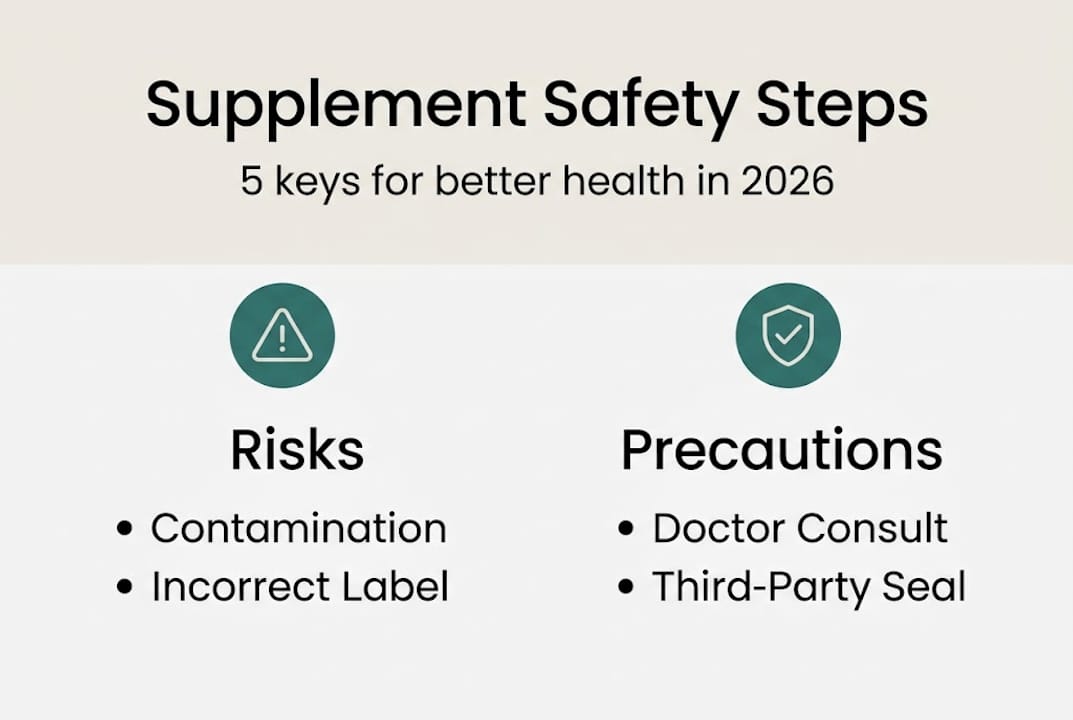
The risks are not limited to contamination. Excessive doses of otherwise safe nutrients can cause organ damage. High vitamin D intake, for example, can lead to hypercalcaemia and kidney stones. Fat-soluble vitamins accumulate in tissue, making overdose a genuine concern with long-term use.
Some groups face heightened risk. Pregnant women, children, cancer patients, and people taking prescription medications all need special caution. Supplements can interfere with chemotherapy, alter blood-thinning medication, or affect absorption of critical drugs. Reviewing supplement regulations overview helps clarify what protections actually exist.
Here is a summary of the most common supplement hazards:
- Contamination: Heavy metals, pesticides, or undisclosed pharmaceutical compounds
- Mislabelling: Incorrect doses or missing active ingredients
- Toxicity: Organ damage from excessive fat-soluble vitamins or minerals
- Drug interactions: Interference with prescription medications
- Vulnerable groups: Pregnant women, children, and those undergoing medical treatment
| Risk type | Example | Potential outcome |
|---|---|---|
| Contamination | Heavy metals in herbal products | Kidney or liver damage |
| Mislabelling | Incorrect potency stated | Under or over-dosing |
| Toxicity | Excess vitamin D | Kidney stones, hypercalcaemia |
| Drug interaction | St. John’s wort with antidepressants | Reduced drug efficacy |
Buying from reputable, certified sources and checking for recognised third-party verifications significantly reduces your exposure to these risks. Reviewing supplement safety tips is a practical first step.
What you need before choosing a supplement
Before purchasing any supplement, a structured self-assessment saves both money and risk. Start by evaluating your current diet, lifestyle habits, and any recent blood work. Many people supplement nutrients they already receive in adequate amounts from food, which adds unnecessary cost and potential risk without benefit.

Consult a doctor before starting supplements, particularly if you take prescription medications or have an existing health condition. A healthcare provider can identify genuine deficiencies through laboratory testing and flag any interactions before they become a problem.
Understanding certifications is equally important. Third-party verification programmes such as USP (United States Pharmacopeia) and NSF International test products for purity, potency, and manufacturing standards. These marks do not guarantee a supplement will work, but they confirm the product contains what the label states and nothing it should not. The supplement overview from Merck Manuals provides a useful reference for understanding what these standards cover.
When reading a label, focus on these elements in order:
- Active ingredients and doses: Confirm the amount per serving matches evidence-based recommendations.
- Inactive ingredients: Check for allergens, fillers, or artificial additives you wish to avoid.
- Third-party certification marks: Look for USP, NSF, or Informed Sport logos.
- Expiry date and storage instructions: Potency degrades over time and with improper storage.
- Warnings and contraindications: These are legally required and should always be read.
When evaluating evidence, prioritise products backed by randomised controlled trials or systematic reviews rather than testimonials or single case studies. Guidance on choosing supplements for healthy ageing outlines which nutrients have the strongest clinical support.
| Certification | What it tests | Recognised by |
|---|---|---|
| USP Verified | Purity, potency, dissolution | Widely accepted globally |
| NSF International | Contaminants, label accuracy | Sports and clinical settings |
| Informed Sport | Banned substances | Athletes and active adults |
Pro Tip: Keep a simple log of every supplement you take, including dose and timing. Share this list with your GP at every appointment. It takes two minutes and prevents a large proportion of avoidable interactions.
How to select and use supplements safely
With your groundwork in place, the practical process of selecting and using supplements becomes straightforward. Begin by cross-referencing any product you consider against reliable databases. Reliable verification sources include the NIH Office of Dietary Supplements, the FDA, and USP-certified product lists. These resources are free and regularly updated.
Follow this process before purchasing:
- Confirm a genuine need: A blood test or dietary analysis should identify the deficiency.
- Choose a certified product: Select only products with recognised third-party verification marks.
- Check for interactions: Use the NIH ODS interaction checker or ask your pharmacist.
- Start with the lowest effective dose: More is not better. Exceeding recommended doses risks toxicity without added benefit.
- Purchase from reputable retailers: Avoid unlabelled bulk powders, unverified online marketplaces, or products with implausible claims.
Never use supplements as a substitute for meals or a varied diet. They are designed to fill specific gaps, not to replace the broad spectrum of nutrients food provides. Reviewing verified supplement advantages clarifies which products have meaningful clinical backing and which are largely unsupported.
Age-specific needs matter too. Adults over 50 often require higher vitamin B12, vitamin D, and calcium, but the appropriate amounts vary by individual. Children and adolescents have entirely different requirements and should not use adult formulations. Vitamin and mineral guidance from Harvard Health provides age-stratified reference values.
Pro Tip: Take fat-soluble vitamins (A, D, E, K) with a meal containing healthy fats to maximise absorption. Water-soluble vitamins like B and C are best taken with water, ideally in the morning.
- Avoid products with proprietary blends that hide individual ingredient doses
- Do not combine multiple supplements containing the same nutrient without calculating total intake
- Store supplements in cool, dry conditions away from direct sunlight
- Discard any product past its expiry date
How to assess supplement effectiveness and stay safe
Using a supplement is only half the process. Monitoring its impact and responding to problems promptly is equally important. After starting a new supplement, track relevant markers over four to eight weeks. These may include energy levels, sleep quality, specific symptoms, or laboratory values if your doctor is monitoring a deficiency.
The FDA monitors adverse events after supplements reach the market, but this system depends on users reporting problems. If you experience a negative reaction, report it via the FDA MedWatch programme or your local medicines authority. Your report contributes to broader safety monitoring that protects other consumers.
Know the difference between mild and serious side effects:
| Side effect category | Examples | Action required |
|---|---|---|
| Mild | Stomach upset, mild headache | Reduce dose or take with food |
| Moderate | Persistent nausea, skin rash | Stop use, consult a pharmacist |
| Severe | Chest pain, difficulty breathing, jaundice | Stop immediately, seek medical care |
For tracking effectiveness, use objective measures where possible. If you began a supplement to address low vitamin D, retest blood levels after three months. Subjective improvements in energy or mood are valid but harder to attribute to a single supplement without controls.
If a supplement is not producing measurable benefit after a reasonable trial period, stopping it is the rational choice. Continuing without evidence of effect adds cost and cumulative exposure without return.
When interpreting scientific evidence, look for multivitamin effectiveness data from large, well-designed trials rather than manufacturer-funded studies. The nutritional supplement guidance resource provides a practical framework for evaluating evidence in the context of healthy ageing.
- Stop any supplement immediately if you develop unusual symptoms
- Reassess your supplement plan at least once per year with your healthcare provider
- Adjust doses if your diet, health status, or medications change
- Do not assume a supplement is safe simply because it has been tolerated previously
The real key to longevity: Why smart supplement use is not enough
Here is the part most supplement guides omit. No amount of careful label-reading or third-party certification replaces the fundamentals of a genuinely healthy lifestyle. Decades of nutritional research are consistent on this point: long-term vitality is built primarily on a varied, nutrient-rich diet, regular physical activity, adequate sleep, and stress management. Supplements are a supporting tool, not a foundation.
The supplement industry is skilled at framing products as solutions to complex health challenges. In reality, a capsule cannot replicate the synergistic effect of whole foods, fibre, phytonutrients, and the hundreds of compounds present in a varied diet. Prudent, discriminating supplement use means taking only what you genuinely need, at evidence-based doses, from verified sources.
Over-reliance on supplements can also create a false sense of security that permits poor dietary choices. Treating a multivitamin as insurance for a low-quality diet is a common and counterproductive pattern. The evidence on graceful ageing consistently points to lifestyle as the primary driver, with targeted supplementation playing a secondary, supportive role.
View safe supplementation as one component within a broader health strategy, not the strategy itself.
Find reliable supplement guidance and quality at Vivetus®
Making informed supplement choices requires access to reliable information and products you can trust. At Vivetus, we curate evidence-backed supplements designed specifically to support healthy ageing and long-term vitality.
Our product range is selected with quality and transparency in mind, and our blog provides regularly updated, science-referenced guidance to help you navigate supplement decisions with clarity. Whether you are assessing a new product, reviewing your current regimen, or looking for targeted support for specific health goals, Vivetus offers the resources and product quality to make that process straightforward. Visit Vivetus to explore our full range and access the latest guidance on evidence-based supplementation.
Frequently asked questions
How can I tell if a supplement is safe to use?
Look for third-party certifications such as USP or NSF and cross-reference the product against reliable supplement resources including the NIH Office of Dietary Supplements and FDA databases.
Are there people who should not take dietary supplements?
Pregnant women, children, cancer patients, and those on prescription medications should seek professional advice before use, as specific groups face heightened risk from interactions or inappropriate dosing.
What are common side effects of supplements?
Mild effects include stomach upset and headaches, while high doses can cause serious harm. Excess vitamin D above 4,000 IU daily can cause hypercalcaemia and kidney stones.
How do dietary supplements interact with medicines?
Many supplements affect how drugs are processed in the body. Vitamin K with blood thinners and St. John’s wort with antidepressants are two well-documented examples with clinically significant consequences.
Should I take supplements or just focus on my diet?
For most adults, a varied diet is the most effective and safest source of nutrients. A diet rich in fruits, vegetables, and whole grains provides nutrients with lower risk than supplementation for those without confirmed deficiencies.