
NAD+ supplementation explained: Benefits, science & outcomes
TL;DR:
- NAD+ is essential for energy production, DNA repair, and cellular health, declining with age.
- Supplementation with precursors like NR and NMN reliably raises blood NAD+ levels.
- Benefits are mainly emerging evidence; NAD+ does not yet proven to reverse aging or extend lifespan.
NAD+ supplements are not all hype, but they are not magic either. As interest in healthy ageing grows, nicotinamide adenine dinucleotide has moved from obscure biochemistry to mainstream supplement shelves. The challenge is separating genuine cellular science from marketing noise. This guide covers what NAD+ actually does inside your body, why levels fall as you age, which supplementation forms have real evidence behind them, and how to apply that knowledge practically. If you are between 30 and 60 and serious about vitality, this is the evidence-based overview you need.
Table of Contents
- Understanding NAD+: The basics and why it matters
- How NAD+ supplementation works: Forms, absorption, and the science
- What the research says: Effects, benefits, and limitations
- Practical guide: Dosage, safety, and getting the most out of supplementation
- A critical look at NAD+ supplementation: What most guides miss
- Add NAD+ supplementation to your healthy ageing toolkit
- Frequently asked questions
Key Takeaways
| Point | Details |
|---|---|
| NAD+ supports essential functions | NAD+ is crucial for energy, DNA repair, and metabolism, with levels declining as we age. |
| Precursors are key for supplementation | Effective supplements use NAD+ precursors like NR and NMN, which are well-absorbed and supported by evidence. |
| Expect modest, researched benefits | Most people see increased NAD+ in the blood and moderate improvements in vitality or cognitive markers—true lifespan extension is unproven. |
| Safety and synergy matter | Short-term use is typically safe for healthy adults; for best results, pair with exercise and healthy habits. |
| Lifestyle is still foundational | Supplements work best alongside—not instead of—good nutrition, sleep, and fitness routines. |
Understanding NAD+: The basics and why it matters
NAD+ stands for nicotinamide adenine dinucleotide. It is a coenzyme, meaning it works alongside enzymes to drive chemical reactions in your cells. Every single cell in your body relies on it. Without adequate NAD+, core biological processes slow down or break down entirely.
The coenzyme’s core roles include energy production, DNA repair, and cellular metabolism. These are not minor background tasks. They are the foundation of how your cells stay functional and resilient over time.
Here is what NAD+ actively supports in the body:
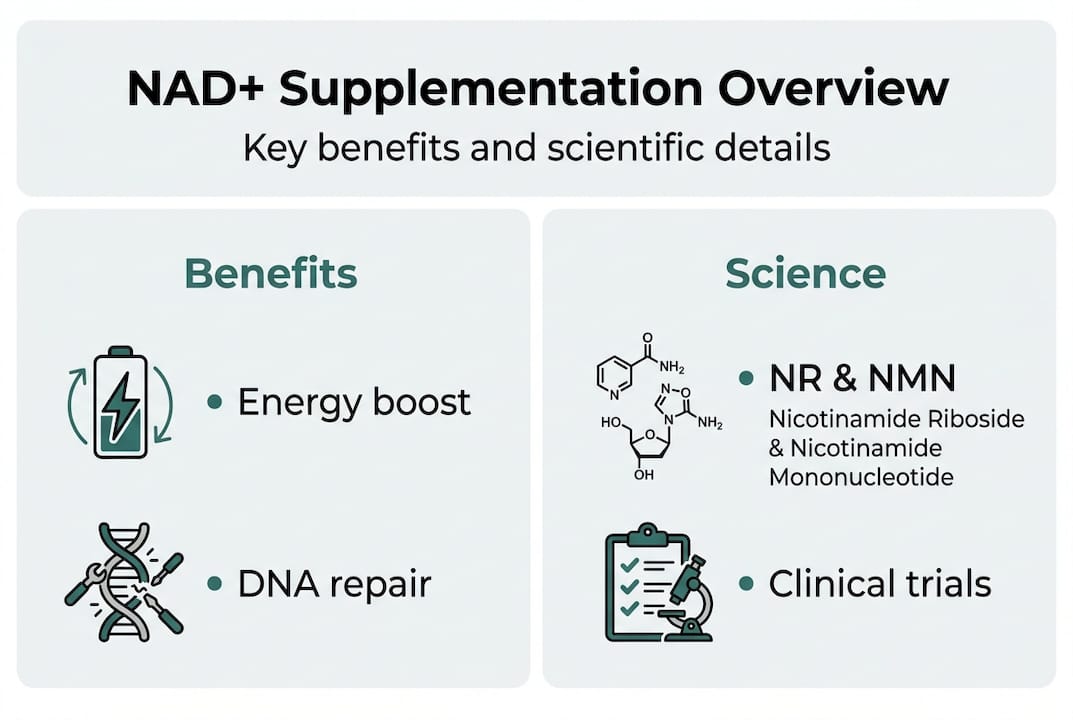
- Energy production: NAD+ is central to the mitochondrial process that converts food into usable cellular energy (ATP).
- DNA repair: It activates enzymes called PARPs, which detect and fix DNA strand breaks before they accumulate.
- Sirtuin activation: Sirtuins are proteins linked to longevity and stress resistance; they require NAD+ to function.
- Circadian rhythm regulation: NAD+ levels fluctuate across the day and help regulate your internal body clock.
- Immune function: Immune cells depend on NAD+ during periods of high metabolic demand.
The critical issue for adults over 30 is that NAD+ levels decline steadily with age. By the time you reach your 50s, levels can be roughly half of what they were in your 20s. This decline is linked to reduced mitochondrial efficiency, slower DNA repair, and increased cellular stress. It is not a fringe theory; it is a measurable biochemical shift that researchers have documented consistently across multiple tissue types.
This is why NAD+ has become central to longevity discussions. Restoring or maintaining NAD+ levels is a logical target for anyone focused on healthy ageing, provided the approach is grounded in evidence rather than enthusiasm.
How NAD+ supplementation works: Forms, absorption, and the science
You cannot simply swallow NAD+ and expect it to reach your cells intact. Direct oral NAD+ has poor bioavailability because it breaks down in the digestive tract before it can be absorbed meaningfully. This is why supplementation relies on precursors: molecules your body converts into NAD+ through established biochemical pathways.
The main precursor types are:
- NR (nicotinamide riboside): Absorbed efficiently, converted via the salvage pathway, and well-studied in human trials.
- NMN (nicotinamide mononucleotide): Converted directly to NAD+ in tissues; strong evidence for blood NAD+ elevation.
- NAM (nicotinamide): Widely available, inexpensive, but can inhibit sirtuins at high doses.
- NA (nicotinic acid/niacin): Effective but causes flushing at higher doses; uses the Preiss-Handler pathway.
The conversion pathways for NR and NMN involve the salvage pathway, while NA uses the Preiss-Handler route. Importantly, gut microbiota can metabolise NR and NMN into NA before absorption, which means some of the effect may be pathway-dependent regardless of the form you take.
| Precursor | Typical dosage | Bioavailability | Key consideration |
|---|---|---|---|
| NR | 250–500 mg/day | Good | Well-tolerated; strong trial data |
| NMN | 250–600 mg/day | Good | Fast conversion; growing evidence |
| NAM | 250–500 mg/day | High | May inhibit sirtuins at high doses |
| NA (niacin) | 15–35 mg/day | High | Flushing common at therapeutic doses |
For those exploring types of NAD+ precursors in more detail, the differences in pathway and tolerability matter when choosing a product. You can also review specific NMN supplement options to compare formulations.
Pro Tip: Look for third-party tested supplements with clear dosage labelling. Combining supplementation with regular exercise amplifies NAD+ production naturally, making the two approaches genuinely synergistic.
What the research says: Effects, benefits, and limitations
Human clinical trials on NAD+ precursors have expanded significantly over the past five years. The results are meaningful but require careful interpretation.

NR and NMN at 300–1000 mg/day consistently raise blood NAD+ levels by approximately two-fold within 14 days. That is a reliable, reproducible finding. What happens after that elevation is where the picture becomes more complex.
| Effect | Study type | Strength of evidence |
|---|---|---|
| Blood NAD+ elevation | Multiple RCTs | Strong |
| Improved left ventricular function (heart failure) | Small RCTs | Moderate |
| Vascular and cognitive function trends | Pilot studies | Preliminary |
| Emotional well-being and vitality | Observational | Weak to moderate |
| Metabolic improvements (weight, insulin) | Mixed RCTs | Inconsistent |
| Lifespan extension | Animal studies only | Not proven in humans |
Human trials show mixed results across outcomes: improved left ventricular ejection fraction in heart failure patients, positive trends in vascular and cognitive function, and some improvement in reported vitality. Metabolic benefits and consistent longevity effects have not been established.
Outcomes supported by current evidence:
- Reliable elevation of blood NAD+ within two weeks
- Potential cardiovascular benefit in clinical heart failure populations
- Trends toward improved vascular function in older adults
- Self-reported improvements in energy and well-being
Outcomes with limited or no current support:
- Reversal of biological ageing markers
- Consistent fat loss or metabolic improvement
- Proven extension of human lifespan
“Supplements that raise NAD+ are promising tools, but they are not substitutes for the lifestyle factors that drive long-term health. The evidence supports cautious optimism, not certainty.”
For a closer look at NMN research findings and NMN anti-ageing outcomes, the data is encouraging but still maturing. Those seeking broader context can review evidence-backed ageing supplements for a wider comparison.
Practical guide: Dosage, safety, and getting the most out of supplementation
For adults aged 30 to 60, NR or NMN at 300–600 mg/day reliably boosts blood NAD+ and is generally well-tolerated in short-term studies. Long-term safety data beyond 12 months remains limited, so this is an important caveat to carry into any supplementation decision.
Who is a reasonable candidate:
- Adults over 35 experiencing reduced energy or recovery capacity
- Those with a family history of age-related metabolic decline
- Individuals already maintaining strong lifestyle foundations (sleep, exercise, nutrition)
Who should consult a doctor first:
- Anyone with a current or past cancer diagnosis (NAD+ supports cell proliferation broadly)
- Those with liver conditions, as NAM in particular is metabolised hepatically
- People on multiple medications, given potential metabolic interactions
Common side effects reported in trials include nausea, headache, fatigue, flushing (particularly with niacin-based forms), and gastrointestinal upset. These are typically mild and dose-dependent.
Monitoring tips:
- Start at the lower end of the dosage range (300 mg/day)
- Track subjective energy and recovery over 4–6 weeks
- Consider blood NAD+ testing before and after if you want objective data
- Review with a healthcare professional if side effects persist
For complementary support, antioxidant support can work alongside NAD+ precursors to address oxidative stress. If you want detailed guidance on using NMN safely over a structured period, that resource covers a practical three-month approach.
Pro Tip: Combine supplementation with regular aerobic exercise and intermittent fasting where appropriate. Both independently raise NAD+ levels, and the combined effect is measurably greater than supplementation alone.
A critical look at NAD+ supplementation: What most guides miss
Most articles on NAD+ supplementation focus on what the science shows. Fewer address what the science does not yet show, and why that gap matters for your decisions.
Blood NAD+ rises by 40–100% within two weeks of supplementation. That is a measurable, consistent result. But a rise in blood NAD+ is a surrogate marker, not a direct measure of anti-ageing effect. Tissue-level NAD+ and its downstream impact on longevity remain areas of active investigation, not settled science.
Experts caution against treating NAD+ supplements as a shortcut to longevity. The framing of NAD+ as a longevity molecule has outpaced the human trial evidence considerably.
“Don’t use supplements as an excuse to skip proven, foundational habits like exercise, sleep, and nutrition.”
The adults who benefit most from NAD+ precursors in clinical settings are those who already maintain strong lifestyle foundations. Supplementation appears to amplify existing healthy behaviour rather than compensate for its absence. This is a critical reframe. If your sleep is poor, your diet is inconsistent, and you are largely sedentary, a 500 mg NMN capsule will not meaningfully change your trajectory.
For a realistic sense of what to expect and when, reviewing a personal timeline for NMN helps set appropriate expectations before you begin. Measurement, patience, and a balanced approach are the hallmarks of effective supplementation.
Add NAD+ supplementation to your healthy ageing toolkit
Supporting healthy ageing is a long-term commitment, not a single purchase. NAD+ precursors are one well-evidenced tool within a broader strategy that includes nutrition, movement, sleep, and targeted supplementation.
At Vivetus, we curate premium NAD+ supplementation and related longevity products selected for quality, third-party testing, and alignment with current scientific evidence. Whether you are beginning your NAD+ journey or refining an existing protocol, our catalogue provides reliable options with transparent ingredient labelling. Free shipping on orders over €50 makes it straightforward to explore what works for your individual health goals without unnecessary barriers.
Frequently asked questions
What is NAD+ and why does it decline with age?
NAD+ is a vital coenzyme involved in energy production and DNA repair, but natural levels decrease steadily as we age, reducing cellular efficiency and resilience.
What is the best form of NAD+ supplement?
NR and NMN are the most studied precursors, both shown to reliably increase blood NAD+ efficiently and safely in most adults at standard doses.
What effects can I expect from NAD+ supplementation?
You can expect a 40–100% rise in blood NAD+ within two weeks, with mixed results across energy, cognitive function, and anti-ageing markers depending on individual baseline and lifestyle.
Are NAD+ supplements safe?
Short-term use at recommended doses is generally well-tolerated, though mild side effects such as nausea or GI upset can occur; long-term safety beyond 12 months is not yet fully established.
Do NAD+ supplements reverse ageing?
No supplement has been proven to reverse ageing in humans; NAD+ precursors support cellular health and energy, but lifespan extension in humans remains unproven.