

Healthy ageing: Evidence-based strategies for vitality
TL;DR:
- Healthy ageing focuses on maintaining functional ability, vitality, and independence over lifespan.
- Monitoring biomarkers like grip strength and gait speed helps predict and prevent decline.
- Lifestyle habits such as regular exercise, proper nutrition, and social engagement are essential for healthy ageing.
Most people assume healthy ageing is simply about adding years to life. That assumption misses the point entirely. WHO defines healthy ageing as developing and maintaining the functional ability that enables wellbeing in older age, not merely surviving longer. For adults aged 50 and above, this distinction is critical. Vitality, independence, and mental sharpness matter far more than a number on a birth certificate. This guide covers the science behind functional ageing, the biomarkers worth monitoring, the lifestyle interventions with the strongest evidence, and how dietary supplements fit into a well-structured approach.
Table of Contents
- Defining healthy ageing: Functional ability over lifespan
- Physiological biomarkers: What signals healthy ageing?
- Lifestyle foundations: Prevention, movement, and social connection
- Dietary supplements for healthy ageing: Evidence and best choices
- Beyond the hype: What most guides get wrong about healthy ageing
- Take your next step towards healthy ageing
- Frequently asked questions
Key Takeaways
| Point | Details |
|---|---|
| Functional ability is key | Healthy ageing is defined by maintaining physical and mental capacity, not just living longer. |
| Monitor practical biomarkers | Grip strength, gait speed, and VO2max predict your health and independence more reliably than molecular tests. |
| Lifestyle first, supplements support | Exercise, nutrition, and social connection are foundational; evidence-based supplements can enhance but not substitute them. |
| Select supplements wisely | Omega-3s, vitamin D, creatine, and plant polyphenols are the best-researched options for boosting vitality. |
Defining healthy ageing: Functional ability over lifespan
Building on the core definition, let us examine what healthy ageing really prioritises beyond just the number of years lived.
“Healthy ageing is defined by the World Health Organization as the process of developing and maintaining the functional ability that enables wellbeing in older age.”
This framework shifts the focus away from disease prevention alone and towards preserving what you can do. The WHO uses two interconnected concepts to explain this: intrinsic capacity and functional ability. Intrinsic capacity refers to the combination of your physical and mental capabilities, including mobility, cognition, vitality, sensory function, and psychological wellbeing. Functional ability is what results when those capacities interact with your environment.
The practical implication is significant. Two people of the same age can have very different trajectories. One may have several chronic conditions but remain mobile, socially engaged, and mentally sharp. Another may have fewer diagnoses but be functionally limited and dependent. The WHO Decade of Healthy Ageing (2021 to 2030) is built around closing that gap.
For adults aged 50 and above, this framework translates into several practical priorities:
- Maintaining physical mobility and strength to perform daily tasks independently
- Preserving cognitive function and psychological resilience
- Staying socially connected and engaged in meaningful activities
- Managing chronic conditions without allowing them to limit functional independence
- Adapting environments and habits to support capacity as it changes over time
Longevity statistics often dominate public health conversations, but functional independence is the real measure of a life well lived. Living to 90 while being confined to a chair for the final 20 years is not the goal. Reaching 80 with the ability to walk, think clearly, and engage with the world around you is. That is what the WHO framework is asking us to aim for, and it is the lens through which every strategy in this guide should be assessed.
Physiological biomarkers: What signals healthy ageing?
With the context of functional ability established, it is crucial to understand how to measure healthy ageing and spot early changes before they become problems.
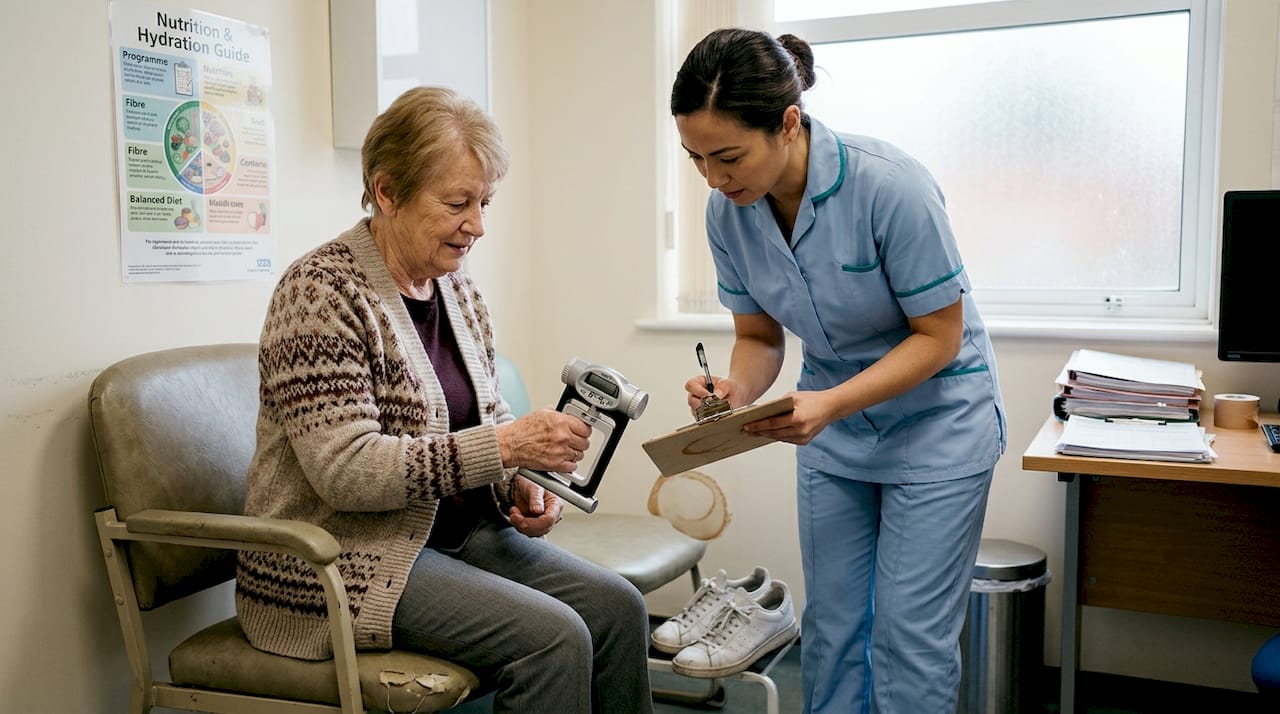
Key physiological biomarkers of healthy ageing include VO2max (cardiorespiratory fitness), grip strength, gait speed, and muscle mass. These four measures predict morbidity, mortality, and functional independence more reliably than many complex molecular markers such as epigenetic clocks. They are also practical. You do not need a laboratory to track most of them.
| Biomarker | What it measures | Target benchmark |
|---|---|---|
| VO2max | Cardiorespiratory fitness | Above 20 ml/kg/min for adults 60+ |
| Grip strength | Muscular strength and overall vitality | Above 26 kg (men), 16 kg (women) |
| Gait speed | Mobility and neurological function | Above 1.0 m/s on a 4-metre walk |
| Muscle mass | Lean tissue and metabolic reserve | Assessed via DEXA or bioimpedance |
Why these matter more than molecular markers: Epigenetic clocks and telomere length are scientifically interesting, but they are not yet actionable for most adults. Grip strength and gait speed, by contrast, are measurable today and directly linked to outcomes. 93% of older adults have at least one chronic condition, and 1 in 4 older adults fall yearly, making these physical benchmarks essential tools for early intervention.
Regular tracking of these measures also helps identify when multimorbidity in older adults begins to affect function, allowing timely adjustments to exercise, nutrition, or supplementation.
Pro Tip: Ask your GP to assess grip strength and gait speed at your next appointment. These simple tests take under five minutes and can reveal functional decline years before symptoms become obvious.
Understanding the nutritional supplement advantages that support these biomarkers is a logical next step once you know which measures need attention. The key is to track first, then intervene with purpose.
Lifestyle foundations: Prevention, movement, and social connection
Now, understanding what to monitor, let us focus on actionable lifestyle changes that yield the biggest impact.
Prevention is foundational to healthy ageing. Physical activity, proper nutrition, preventive healthcare, and social engagement are the four pillars endorsed by the WHO Decade of Healthy Ageing (2021 to 2030). No supplement replaces these. They are the substrate on which everything else is built.
“Movement is not optional for healthy ageing. It is the single most evidence-backed intervention available to adults over 50.”
Here is a practical framework for applying the four pillars:
- Physical activity: Aim for at least 150 minutes of moderate aerobic activity per week, plus muscle-strengthening exercises on two or more days. Walking, swimming, cycling, and resistance training all count. Consistency matters more than intensity.
- Nutrition: Prioritise whole foods, adequate protein (1.2 to 1.6 g per kg of body weight daily), and a wide variety of plant-based foods. Reduce ultra-processed foods and excess sodium. Hydration is frequently underestimated in adults over 50.
- Preventive healthcare: Schedule regular screenings for blood pressure, cholesterol, blood glucose, bone density, and vision. Early detection allows early action. Do not wait for symptoms.
- Social engagement: Loneliness is associated with accelerated cognitive decline and increased mortality risk. Regular social contact, whether through family, community groups, or structured activities, is not a lifestyle luxury. It is a health intervention.
Pro Tip: Pair a daily 30-minute walk with a social commitment, such as walking with a friend or joining a local walking group. You address two pillars simultaneously, and the social accountability improves adherence.
Once these foundations are in place, you can explore the healthy ageing supplements guide for targeted nutritional support that builds on, rather than substitutes for, these core habits.
Dietary supplements for healthy ageing: Evidence and best choices
With lifestyle as the foundation, supplementation can play a supportive role when backed by evidence.
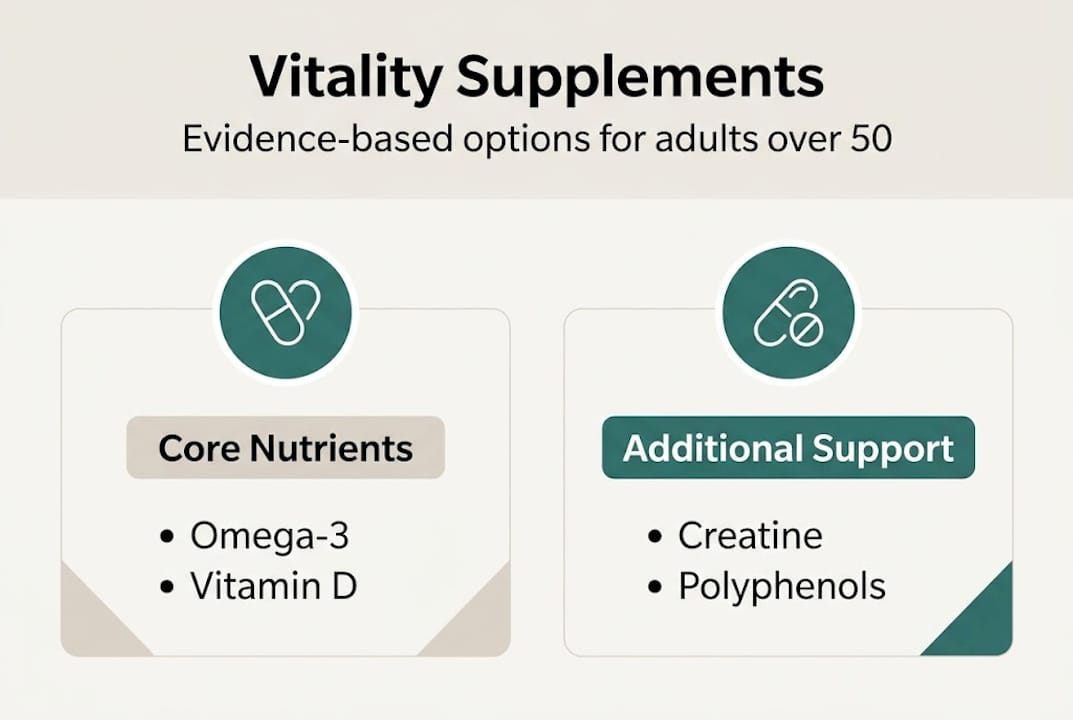
Evidence supports omega-3 fatty acids, vitamin D, and creatine for vitality, while plant-based diets rich in polyphenols and micronutrients enhance longevity by reducing inflammation and supporting mitochondrial function. These are not fringe claims. They are drawn from peer-reviewed research and supported by anti-aging vitamin evidence across multiple study designs.
| Supplement | Primary benefit | Cautionary note |
|---|---|---|
| Omega-3 fatty acids | Heart, brain, and joint health | Check for interactions with blood thinners |
| Vitamin D3 | Bone density, immune function, mood | Test serum levels before supplementing |
| Creatine monohydrate | Muscle mass, strength, cognitive support | Ensure adequate hydration |
| Polyphenols (e.g., resveratrol, quercetin) | Anti-inflammatory, mitochondrial support | Bioavailability varies by product form |
| Magnesium | Muscle function, sleep quality, nerve health | Choose glycinate or malate for absorption |
When selecting supplements, apply these criteria:
- Look for third-party testing and certification (e.g., NSF, Informed Sport)
- Choose products with clinically studied dosages, not proprietary blends that obscure amounts
- Prioritise single-ingredient products where possible for clearer cause-and-effect tracking
- Consult a GP or registered dietitian before adding multiple supplements simultaneously
For practical guidance on selecting the right products, the top products for healthy ageing resource provides structured recommendations. If you are newer to supplementation, how to choose healthy ageing supplements offers a step-by-step framework for making informed decisions without being overwhelmed by the market.
Beyond the hype: What most guides get wrong about healthy ageing
Most healthy ageing content leads with supplements and circles back to lifestyle as an afterthought. That order is backwards. Functional ability and longevity are driven primarily by what you do every day, not what you take in capsule form. Omega-3s and vitamin D are genuinely useful. But they cannot compensate for sedentary behaviour, poor sleep, or social isolation.
Another common error is chasing molecular biomarkers such as telomere length or biological age scores. These are interesting data points, but they do not tell you what to do on Monday morning. Grip strength and gait speed do. They are measurable, actionable, and directly predictive of outcomes that matter.
The most practical lesson from recent science is this: track the basics, apply the lifestyle interventions consistently, and use evidence-based supplements as targeted support. That sequence produces results. Reversing it produces expensive urine and frustration. For a more structured approach to supplementation within this framework, the in-depth supplement guide is a useful reference point.
Take your next step towards healthy ageing
Understanding the science is the first step. Applying it is where results are made. Vivetus provides evidence-based supplement guides and product recommendations designed specifically for adults aged 50 and above, covering everything from omega-3 selection to vitamin D dosing and creatine protocols.
Whether you are building a supplement routine from scratch or refining an existing one, Vivetus healthy ageing solutions offers structured resources to guide your decisions. Products are selected based on clinical evidence, third-party testing, and relevance to the biomarkers and lifestyle pillars covered in this guide. Free shipping is available on orders over €50, making it straightforward to access quality nutrition support without unnecessary cost.
Frequently asked questions
What is the best single indicator of healthy ageing?
Grip strength is considered a practical and reliable indicator, predicting morbidity and independence better than many molecular markers. It is simple to measure and directly linked to functional outcomes.
Are supplements alone enough for healthy ageing?
Supplements should complement, not replace, lifestyle interventions such as exercise, nutrition, and social engagement. Lifestyle remains primary for healthy ageing outcomes.
Which supplements have evidence for improving vitality in adults over 50?
Omega-3 fatty acids, vitamin D, creatine, and polyphenols have robust evidence supporting their roles in vitality and longevity for adults aged 50 and above.
How much physical activity is recommended for healthy ageing?
The WHO recommends at least 150 minutes of moderate aerobic activity plus muscle strengthening every week for adults aged 50 and above.