

Cellular health explained: How to support healthy ageing
TL;DR:
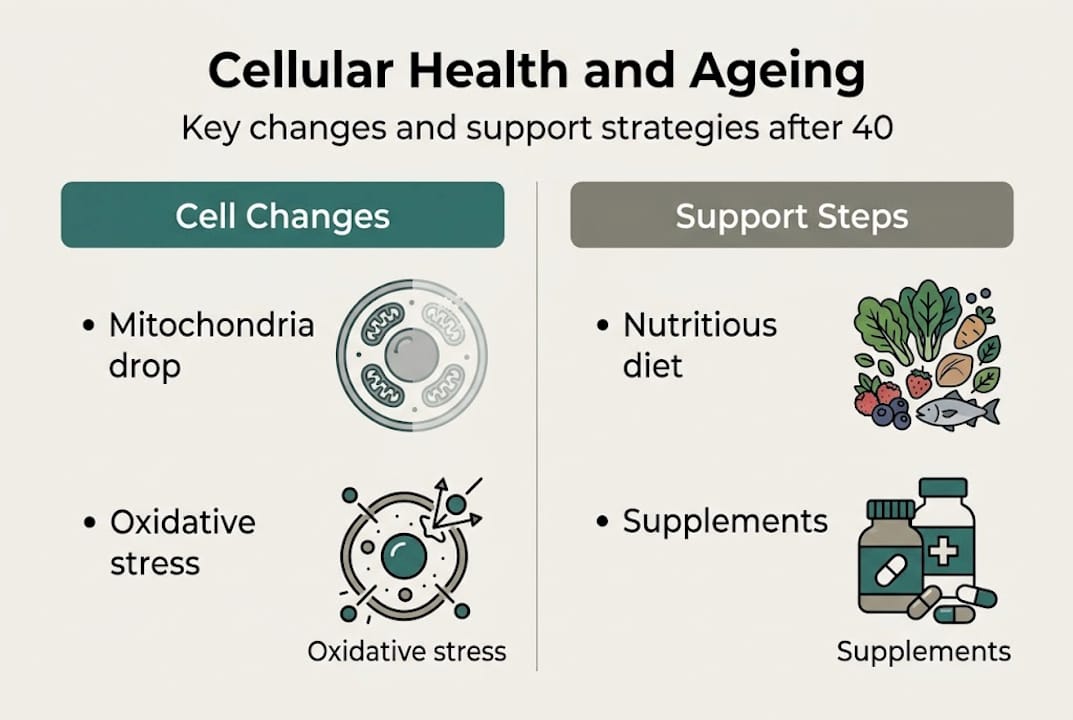
- Cellular health declines after 40 due to mitochondrial, oxidative stress, mitophagy, and senescent cell changes.
- Supplements like CoQ10 and NAD+ precursors show promise but require careful evaluation of evidence and safety.
- Combining targeted supplements with healthy lifestyle habits is most effective for supporting long-term cellular health.
Most people assume that taking a daily multivitamin is enough to keep their cells in good shape. It is not. Cellular health is far more specific than general nutrition, and after 40, the processes that keep your cells functioning well begin to shift in ways that no single supplement can fully address. Understanding what cellular health actually means, how it changes with age, and which supplements have genuine evidence behind them gives you a practical foundation for making better decisions. This article covers all of it, clearly and without unnecessary complexity.
Table of Contents
- What is cellular health and why is it important?
- How ageing affects your cells after 40
- Supplements for cellular health: Do they work?
- Limitations, risks, and the future of cellular health supplements
- Our perspective: What most people miss about cellular health
- Next steps: Explore evidence-based cellular health support
- Frequently asked questions
Key Takeaways
| Point | Details |
|---|---|
| Cellular health declines with age | After 40, changes in mitochondria and increased oxidative stress make cellular support crucial for wellbeing. |
| Supplements can help—but are not magic | Evidence supports some supplements like CoQ10 and multinutrient blends, but no single pill reverses ageing. |
| Comprehensive approach works best | Combining the right supplements with diet, exercise, and smart routines delivers the greatest cellular health benefit. |
| Check evidence and safety | Always consider clinical research, aim for multi-target strategies, and consult professionals to avoid risks. |
What is cellular health and why is it important?
Cellular health refers to how well your individual cells carry out their core functions: producing energy, repairing damage, communicating with other cells, and clearing out waste. When these processes work efficiently, the body functions well. When they falter, the effects show up across every organ and system.
Four pillars underpin cellular health as we age:
- Mitochondrial function: Mitochondria generate the energy (ATP) your cells need. Declining output means less energy at the cellular level.
- Oxidative stress management: Cells produce reactive oxygen species (ROS) as a byproduct of energy production. Antioxidant systems neutralise these, but the balance shifts with age.
- Mitophagy: This is the process by which damaged mitochondria are identified and cleared. When mitophagy slows, dysfunctional mitochondria accumulate.
- Senescent cell clearance: Senescent cells are old, damaged cells that stop dividing but remain in tissue, releasing inflammatory signals. Their accumulation is a hallmark of biological ageing.
As the evidence shows, cellular health declines due to mitochondrial dysfunction, increased ROS, impaired mitophagy, and accumulation of senescent cells. This is not a slow, invisible process. It has direct consequences for energy levels, joint function, immune response, and cognitive sharpness.
“The accumulation of dysfunctional cells is not simply a marker of ageing. It is an active driver of the conditions most associated with it.”
For anyone over 40, this matters because the decline is gradual enough to go unnoticed until it reaches a threshold. Fatigue, slower recovery, and reduced mental clarity are often attributed to lifestyle factors when the root cause is cellular. Exploring supplements for cellular ageing becomes relevant once you understand what is actually declining at the cellular level.
Now that we have set the stage for why cellular health matters, let us explore what actually happens to our cells as we age.
How ageing affects your cells after 40
After 40, cellular changes that were previously slow begin to accelerate. Mitochondrial output drops, oxidative stress increases, and the body’s repair mechanisms become less responsive. These are not theoretical concerns. They produce measurable, real-world outcomes.
| Cellular change | Effect on the body | Symptoms you may notice |
|---|---|---|
| Mitochondrial decline | Less ATP production | Fatigue, reduced stamina |
| Increased oxidative stress | Cell membrane and DNA damage | Slower recovery, skin changes |
| Reduced mitophagy | Build-up of damaged mitochondria | Brain fog, low energy |
| Senescent cell accumulation | Chronic low-grade inflammation | Joint stiffness, immune changes |
| Reduced protein synthesis | Muscle loss (sarcopenia) | Weaker grip, slower gait |
These changes compound over time. Research into protein-based multinutrient therapy in a meta-analysis of 10 randomised controlled trials (n=1,359) found improvements in handgrip strength (MD=0.33 kg) and gait speed (MD=0.15 m/s) in sarcopenic older adults. This is significant because grip strength and walking speed are reliable indicators of overall cellular and metabolic health in midlife and beyond.
Cognition is also affected. Neurons are particularly energy-dependent, so mitochondrial decline in brain cells contributes to slower processing and reduced memory consolidation. The same applies to cardiac cells, which require constant, high-level energy output.

For practical guidance on what to look for in products for cellular support, understanding these mechanisms helps you filter options based on what the evidence actually targets.
Pro Tip: The earlier you address cellular decline, the greater the long-term benefit. Starting targeted support in your 40s gives your cells more to work with than waiting until symptoms are pronounced.
Understanding what is happening inside our cells, the next step is how to protect and support them as we age.
Supplements for cellular health: Do they work?
The honest answer is: some do, some show promise, and some are overstated. The category matters, and so does the evidence behind each option.
CoQ10 is one of the most studied. CoQ10 levels decline with age and with statin use, and supplementation may support heart function and energy metabolism, particularly in those with cardiovascular conditions or diabetes. It is a mitochondrial cofactor, meaning it directly supports the energy production process.
NAD+ precursors (such as NMN and NR) have attracted significant attention. They support NAD+ synthesis, which declines sharply after 40 and is critical for mitochondrial function and DNA repair. However, the evidence in humans remains limited, which we address in the next section.
Multi-ingredient formulas targeting multiple ageing hallmarks simultaneously are an emerging category. Clinical trials on formulas such as Cel System and NOVOS Core show promise in slowing epigenetic ageing and improving muscle strength in older adults.
| Supplement | Mechanism | Evidence strength | Safety profile |
|---|---|---|---|
| CoQ10 | Mitochondrial energy support | Strong for cardiac/energy use | Generally well tolerated |
| NMN/NR (NAD+ precursors) | NAD+ synthesis, DNA repair | Promising, limited human data | Generally safe, short-term |
| Mitochondrial antioxidants | Reduce ROS at source | Moderate | Varies by compound |
| Multi-ingredient formulas | Target multiple ageing pathways | Growing clinical evidence | Depends on formulation |
To evaluate any supplement sensibly, follow these steps:
- Check whether human clinical trials exist, not just animal or cell studies.
- Look for peer-reviewed publications, not only brand-funded research.
- Confirm the dose used in trials matches what the product contains.
- Review antioxidants with scientific backing to compare options.
- Consult a healthcare professional, particularly if you take prescription medicines.
For a broader overview, the 2026 supplement guide for ageing covers the latest evidence across multiple categories relevant to adults over 40.
If you are considering supplements, it is important to know not only which are promising but also how to approach them safely and with the right expectations.
Limitations, risks, and the future of cellular health supplements
Not every supplement that targets a cellular mechanism will produce meaningful improvements in how you feel or function. This distinction matters. A supplement can show measurable changes in a biomarker without translating to better energy, mobility, or quality of life.
Key limitations to be aware of:
- Most human trials are short-term (under 12 months), making long-term safety and efficacy harder to assess.
- Biomarker improvements do not always correlate with functional outcomes.
- Individual responses vary significantly based on genetics, diet, and baseline health.
On the risk side, the main concerns are gastrointestinal side effects (nausea, loose stools), interactions with anticoagulants or statins, and the risk of over-supplementation when combining multiple products.
Red flags when evaluating a new supplement:
- Claims of reversing ageing without clinical trial data
- No information on dosage or ingredient sourcing
- Proprietary blends that obscure individual ingredient amounts
- No mention of potential interactions or contraindications
The evidence on NAD+ precursors illustrates the gap between preclinical promise and human results well. While animal studies are compelling, human trials show limited efficacy for ageing outcomes specifically. This does not mean the research is without value, but it does mean caution is warranted before investing heavily in these products.
“Preclinical data is a starting point, not a conclusion. Human ageing is far more complex than any cell culture or mouse model can replicate.”
For a practical overview of what to consider before starting any new regimen, the nutritional supplements guide for healthy ageing and supplement safety tips are useful references.
Equipped with these facts, let us summarise what really matters for supporting your cellular health over time.
Our perspective: What most people miss about cellular health
Mainstream coverage of cellular health tends to focus on individual supplements as if they were standalone solutions. CoQ10 gets a headline. NAD+ precursors get a trend cycle. But cellular health is not a single-target problem, and treating it as one is where most people go wrong.
What the research consistently shows is that combination supplement strategies paired with dietary quality, regular resistance exercise, and adequate sleep produce outcomes that no supplement achieves on its own. The supplements serve as support, not substitutes.
The other thing most people miss is timing. Starting in your 40s, before significant decline has occurred, gives interventions far more to work with. Waiting until your 60s is not too late, but the trajectory is harder to shift.
Pro Tip: Build a routine you can maintain consistently. A modest, evidence-backed supplement protocol followed reliably over two years will outperform an aggressive short-term approach every time. Monitor how you feel, track functional markers like energy and strength, and adjust based on results.
Next steps: Explore evidence-based cellular health support
Understanding cellular health gives you a real advantage when choosing how to support your body after 40. The science is specific, the options are growing, and the decisions you make now have long-term consequences.

At Vivetus, we bring together evidence-based guides and quality supplement options selected for adults who take healthy ageing seriously. Whether you are starting your research or refining an existing routine, our resources are designed to help you make informed, practical choices. Free shipping is available on orders over €50, and our product range is accessible to customers across Europe and beyond. Browse our catalogue and take the next step with confidence.
Frequently asked questions
Which cellular health supplements are best for adults over 40?
CoQ10 and targeted multi-ingredient formulas have the strongest evidence for supporting energy production and muscle strength in older adults.
Are there risks to taking cellular health supplements?
Some supplements may cause digestive side effects or interact with medicines; human trial data on newer options like NAD+ precursors remains limited, so always consult a professional before starting.
How quickly can I expect results from cellular health supplements?
Small improvements in energy or muscle strength may appear within weeks, but meaningful functional gains require consistent, long-term use alongside dietary and lifestyle changes.
Can a healthy diet and exercise replace supplements for cellular health?
Diet and exercise are foundational, but some age-related cellular declines may benefit from evidence-based supplementation; multi-target approaches consistently outperform single supplements or lifestyle changes alone.