
The role of calcium in aging: what you need to know
TL;DR:
- As people age, their ability to absorb calcium decreases due to declining vitamin D levels and rising parathyroid hormone levels. Adequate intake of 1,000 to 1,200 mg of calcium daily, combined with vitamin D, magnesium, and physical activity, supports bone health and cellular function. Over-supplementation beyond individual needs can increase health risks, making personalized assessment and targeted nutrition essential.
Calcium is the most abundant mineral in the human body, and its role in aging extends far beyond keeping bones strong. As you age, your body absorbs calcium less efficiently, your hormonal balance shifts, and the consequences reach into cellular function, muscle performance, and long-term vitality. Net calcium absorption drops from around 60% in infants to roughly 25% in adults, and it continues to fall with each passing decade. Understanding how calcium affects aging gives you a clear path to protecting your health now, not after problems appear.
How does calcium absorption change as we age?
The body’s ability to absorb and manage calcium declines steadily with age. This is not simply a matter of eating less dairy. The underlying physiology changes in ways that make calcium management genuinely harder for older adults.
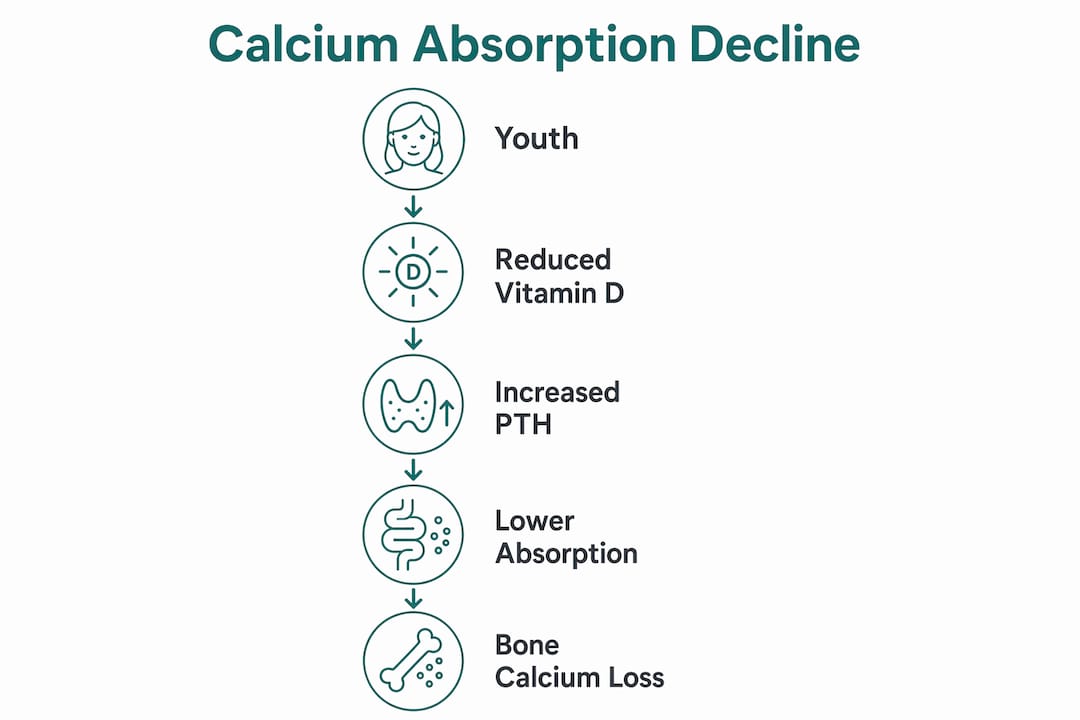
The most significant driver is a drop in vitamin D synthesis. Ageing skin produces less vitamin D from sunlight, and the kidneys become less efficient at converting it into its active form. Vitamin D is what tells the intestines to absorb calcium from food. Without enough of it, calcium passes through the gut largely unused.
At the same time, parathyroid hormone (PTH) levels rise by 5–6% per decade between the ages of 20 and 98. PTH is the body’s emergency calcium manager. When blood calcium falls too low, PTH signals the bones to release calcium into the bloodstream. This keeps your blood levels stable, but it does so by drawing calcium directly out of bone tissue, accelerating bone loss over time.
The net result is a shift in bone remodelling. In younger adults, bone formation and bone resorption stay roughly balanced. In older adults, resorption outpaces formation, reducing bone density and raising fracture risk. This process is gradual and largely silent until a fracture occurs.
Key physiological changes affecting calcium in older adults:
- Vitamin D synthesis in the skin declines significantly after age 60
- Intestinal calcium absorption efficiency falls with lower active vitamin D
- PTH rises progressively, pulling calcium from bone to maintain blood levels
- Bone resorption outpaces formation, reducing density over time
- Oestrogen decline in postmenopausal women accelerates bone loss further
Pro Tip: Getting a simple blood test for vitamin D and PTH levels gives you a concrete starting point. Many older adults are deficient in vitamin D without knowing it, and correcting that deficiency is one of the most direct ways to support calcium absorption.
What do clinical guidelines recommend for calcium intake?
Current clinical guidance recommends 1,000–1,200 mg of total daily calcium for adults aged 51 and over, with a safe upper limit of 2,000 mg per day. These figures cover calcium from all sources combined, including food and any supplements you take.
The rationale behind these numbers is primarily defensive. The primary goal of calcium intake is to prevent the body from resorbing calcium from bones to maintain blood calcium levels during ageing. Keeping dietary intake adequate reduces the hormonal pressure to strip calcium from bone.
However, the evidence behind some of the higher recommendations is worth examining. Modern reviews suggest that 700 mg of dietary calcium may be sufficient for many adults, including postmenopausal women, with higher targets based largely on short-term studies. This does not mean lower is always better. It means that chasing very high intakes through supplements alone is not supported by strong long-term fracture prevention data.
| Intake level | Context |
|---|---|
| 700 mg dietary | May suffice for many adults per modern evidence reviews |
| 1,000–1,200 mg total | Current guideline target for adults aged 51 and over |
| 2,000 mg total | Safe upper limit; do not exceed from combined sources |
| Above 2,000 mg | Associated with potential cardiovascular and kidney risks |
Pro Tip: Track your dietary calcium for a week before adding supplements. Most adults get 400–600 mg from food alone. Knowing your baseline prevents you from over-supplementing without realising it.
How does calcium interact with vitamin D and other nutrients?

Calcium does not work in isolation. Its absorption, storage, and use in the body depend heavily on vitamin D and several other nutrients. Taking calcium without addressing vitamin D status is like filling a bath with the plug out.
Combining calcium with vitamin D supplementation reduces hip and fragility fracture risk more effectively than calcium alone, particularly in adults over 70. Vitamin D activates proteins in the intestinal lining that physically transport calcium into the bloodstream. Without adequate vitamin D, even a high dietary calcium intake produces limited results.
Other nutrients also play a supporting role:
- Magnesium helps regulate PTH and supports bone mineralisation alongside calcium
- Vitamin K2 directs calcium into bone tissue rather than soft tissue or arteries
- Phosphorus works with calcium in the structural matrix of bone
- Protein supports bone collagen, which gives bone its flexibility and fracture resistance
The practical implication is clear. A combined nutrient approach to bone health outperforms single-nutrient supplementation. Adults who take calcium alone without addressing vitamin D, magnesium, or vitamin K2 are addressing only part of the problem. For a detailed look at how vitamin D fits into this picture, Vivetus has published a complete guide for seniors covering dosage, deficiency signs, and supplementation guidance.
Calcium also functions as a critical second messenger in cellular signalling. Disruptions in calcium homeostasis are linked to cellular senescence, the process by which cells stop dividing and begin to contribute to tissue ageing. This means calcium’s influence on how you age extends well beyond bone density into the fundamental biology of your cells.
What are the best practical strategies for calcium intake in older adults?
Getting enough calcium consistently requires a combination of food choices, smart supplementation, and lifestyle habits. No single approach covers all the bases.
Prioritise food sources first
Dairy products remain the most concentrated dietary calcium sources. A 200 ml glass of milk provides roughly 240 mg of calcium. Hard cheeses, yoghurt, and fortified plant milks are equally effective. Non-dairy sources include:
- Tinned sardines and salmon with bones (around 200–350 mg per serving)
- Kale, bok choy, and broccoli (lower in calcium but highly absorbable)
- Fortified breakfast cereals and orange juice
- Tofu set with calcium sulphate
- Almonds and white beans
Use supplements correctly
Taking calcium supplements with meals improves absorption and reduces gastrointestinal side effects such as bloating and constipation. An empty stomach produces less acid, and calcium carbonate in particular requires stomach acid to dissolve properly. Calcium citrate is absorbed slightly better on an empty stomach, but taking either form with food remains the safer and more comfortable approach for most adults.
Split your supplement dose if you take more than 500 mg per day. The body absorbs calcium in smaller amounts more efficiently than in a single large dose.
Avoid over-supplementation
Excessive calcium supplementation does not increase bone density beyond what adequate intake achieves, and it may raise cardiovascular risk. The concern centres on calcium deposits in arterial walls when blood calcium is consistently elevated beyond physiological needs. Staying within the 2,000 mg total daily limit is the clearest safety boundary currently supported by evidence.
Support bone health with physical activity
Weight-bearing exercise, including walking, resistance training, and stair climbing, stimulates bone formation directly. Physical activity does not replace calcium, but it amplifies its effect on bone density. Adults who combine adequate calcium intake with regular weight-bearing activity maintain bone density more effectively than those who rely on nutrition alone.
Pro Tip: If you take a calcium supplement, pair it with vitamin K2 (MK-7 form). Vitamin K2 activates osteocalcin, a protein that binds calcium into bone tissue rather than allowing it to accumulate in soft tissue. This combination is increasingly supported by bone health research.
For women over 40 considering supplementation, Vivetus has published a detailed calcium supplements guide covering specific dosage considerations and what to look for in a quality product.
Key takeaways
Adequate calcium intake throughout ageing is a defensive strategy: it reduces the hormonal pressure to strip calcium from bone, supports cellular function, and works most effectively when combined with vitamin D, magnesium, and weight-bearing activity.
| Point | Details |
|---|---|
| Absorption declines with age | Calcium absorption falls from 60% in infants to 25% in adults and continues to drop. |
| PTH rises progressively | Parathyroid hormone increases 5–6% per decade, pulling calcium from bone to maintain blood levels. |
| Guideline target is 1,000–1,200 mg | Adults aged 51 and over need this total daily from food and supplements combined. |
| Vitamin D is non-negotiable | Calcium and vitamin D together reduce fracture risk more than calcium alone, especially over age 70. |
| Supplements work best with meals | Taking calcium with food improves absorption and reduces gastrointestinal discomfort. |
Calcium’s role goes further than most people realise
People tend to think of calcium as a bone mineral and nothing more. That framing is understandable, but it misses a significant part of the picture.
Calcium acts as a cellular messenger. It regulates muscle contraction, nerve signalling, and the behaviour of individual cells as they age. Research now links disruptions in calcium homeostasis to cellular senescence, the process by which ageing cells stop functioning properly and begin to drive tissue decline. Managing calcium at the cellular level may eventually become a therapeutic target for extending healthy lifespan, not just for preventing fractures.
What I find most striking is how often older adults either under-supplement or over-supplement, with neither approach grounded in their actual dietary intake. The people who do best are those who treat calcium as part of a broader nutritional picture: adequate vitamin D, some magnesium, regular movement, and a diet that provides a reasonable baseline before any supplement is added.
The caution around over-supplementation is real and worth taking seriously. Calcium beyond physiological needs does not build stronger bones. It simply raises blood levels unnecessarily, and the cardiovascular implications of that are still being studied. The answer is not to avoid calcium. It is to be deliberate about how much you actually need.
My practical advice: get your vitamin D and PTH levels checked, calculate your dietary calcium intake honestly, and supplement only the gap. That approach is more effective, safer, and far less expensive than blanket high-dose supplementation.
— Jord
Vivetus and healthy ageing through targeted nutrition
Calcium and vitamin D do not exist in isolation, and neither should your supplement plan.
Vivetus specialises in nutritional supplements designed specifically for healthy ageing, with formulations that reflect current clinical thinking on calcium, vitamin D, and bone health. Whether you are looking to close a dietary gap or build a more complete nutritional foundation, the Vivetus range covers the key nutrients that work alongside calcium to support bone density and cellular health. Free shipping is available on orders over €50. Browse the healthy ageing supplement range and find the products most relevant to your needs.
FAQ
What is the role of calcium in aging?
Calcium maintains bone density, supports muscle and nerve function, and acts as a cellular messenger. As you age, absorption declines and hormonal changes increase bone resorption, making adequate intake more critical.
How much calcium do older adults need each day?
Clinical guidelines recommend 1,000–1,200 mg of total daily calcium for adults aged 51 and over, with a safe upper limit of 2,000 mg from all sources combined.
Does calcium deficiency accelerate aging?
Calcium deficiency triggers higher parathyroid hormone levels, which draw calcium from bone to maintain blood levels. Over time, this accelerates bone loss and raises fracture risk significantly.
Is it better to get calcium from food or supplements?
Dietary calcium is preferable because it comes with co-nutrients that support absorption. Supplements are useful for closing a genuine gap, but excessive supplementation beyond physiological needs does not add bone benefit and may carry cardiovascular risk.
Why does vitamin D matter for calcium absorption?
Vitamin D activates the intestinal proteins that transport calcium into the bloodstream. Without sufficient vitamin D, calcium absorption falls sharply regardless of how much calcium you consume.