
Quercetin dosage guide: safe daily amounts explained
For most adults, a daily quercetin supplement of 250–500 mg is appropriate for general maintenance. Clinical trials have used 500–1,000 mg/day for several weeks, and some acute protocols have tested up to 2,000 mg for short courses. Average dietary intake from food sits at roughly 5–40 mg/day, so even a modest supplement dose represents a meaningful step up from what most people get through diet alone.
Three immediate points before you proceed:
- Who should seek medical advice first: anyone taking anticoagulants, antiplatelet agents, or multiple prescription medicines should speak with a clinician before starting quercetin, as CYP enzyme interactions are possible.
- Pregnancy and breastfeeding: quercetin supplements are not recommended during pregnancy or breastfeeding due to insufficient safety data; avoid unless under direct medical supervision.
- Higher doses require monitoring: doses above 500 mg/day, and particularly above 1,000 mg/day, are outside the conservative safety anchor set by the Norwegian Scientific Committee for Food and Environment (VKM) and should only be used under clinical supervision with periodic liver and kidney checks.
Pro Tip: If you are on any regular medication, bring the supplement label to your next GP appointment rather than self-adjusting your dose upward.
Key takeaways
For most healthy adults, 250–500 mg of quercetin per day is the evidence-supported maintenance dose, with clinical trials using up to 1,000 mg/day for short therapeutic courses under appropriate monitoring.
| Point | Details |
|---|---|
| Maintenance dose range | 250–500 mg/day is appropriate for general healthy ageing; aligns with the VKM safety anchor. |
| Clinical trial ceiling | 500–1,000 mg/day is used in most RCTs; doses up to 2,000 mg/day require clinical supervision. |
| Formulation matters | Quercetin Phytosome® delivers markedly higher absorption; label milligrams are not directly comparable across forms. |
| Key interaction risk | Anticoagulants and CYP-metabolised drugs require clinician oversight before combining with quercetin. |
| Vivetus Quercetin | Delivers 500 mg standardised quercetin per capsule, purity-tested and available across Central Europe. |
Consult your clinician for personalised dosing advice, particularly if you take prescription medicines or plan to use doses above 500 mg/day.
This article provides general information and is not a substitute for professional medical advice. Confirm dosing decisions with a qualified healthcare professional.
Table of Contents
- What do clinical studies say about quercetin dosing?
- How does formulation affect how much quercetin you actually absorb?
- How and when should you take quercetin?
- What are the side effects and drug interactions you should know?
- What dosing plan fits your goal?
- How to choose a quercetin product that matches the evidence
- Why conservative dosing is the right starting point
- Vivetus Quercetin: a straightforward option for Central Europe
- Primary sources and further reading
- Sources
What do clinical studies say about quercetin dosing?
The evidence base for quercetin covers a wide span of doses. Understanding which dose belongs to which context helps you avoid both under-dosing and unnecessary risk.
Plasma response at 500 mg and 1,000 mg/day
A large 12-week randomised trial (N=1,002) found that 500 mg/day produced a net fasting plasma increase of ~332 μg/l, while 1,000 mg/day produced ~516 μg/l, compared with ~54 μg/l for placebo. Both doses raised plasma quercetin substantially, yet the variability between individuals was high, meaning two people on the same dose can end up with very different plasma levels. Formulation, diet, and individual metabolism all contribute to that spread.
At lower doses, a two-week pharmacokinetic study found dose-dependent plasma increases of 178% at 50 mg/day, 359% at 100 mg/day, and 570% at 150 mg/day, with a median time to peak concentration of around 120–360 minutes and an elimination half-life of approximately 14–17 hours. No changes in antioxidant markers were detected at these lower doses in healthy volunteers, which suggests that measurable functional effects may require higher sustained intake.
Dose ranges across study types
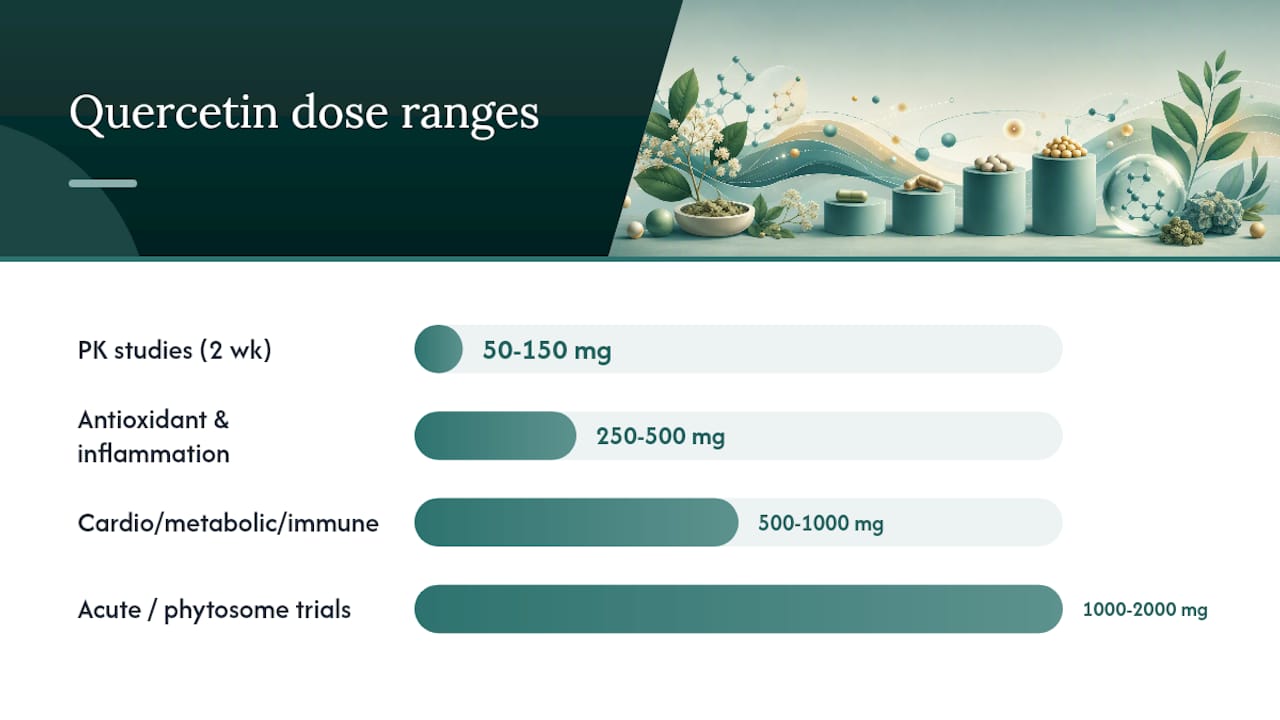
Clinical studies and reviews report a dosing range of approximately 250–2,000 mg/day depending on the condition studied, with treatment durations ranging from a few days to 12 months.
| Dose range | Typical study context | Observed plasma/outcome effects | Evidence strength |
|---|---|---|---|
| 50–150 mg/day | PK studies, 2 weeks | Dose-dependent plasma increase; no antioxidant marker change | Preliminary PK data |
| 250–500 mg/day | Antioxidant, inflammation trials | Plasma accumulation; modest clinical endpoints | Moderate; multiple RCTs |
| 500–1,000 mg/day | Cardiovascular, metabolic, immune trials | Significant plasma rise; clinical endpoints in some trials | Moderate to good |
| 1,000–2,000 mg/day | Acute protocols, phytosome trials | Improved endpoints in pilot studies; tolerability acceptable short-term | Limited; pilot and supervised studies |
The high interindividual variability in plasma response is a practical consideration. It means that a dose that saturates plasma in one person may produce only a modest rise in another. This is one reason conservative maintenance dosing is sensible for unsupervised use, and why formulation choice matters as much as the milligram figure on the label.
How does formulation affect how much quercetin you actually absorb?
Standard quercetin aglycone has low and variable oral bioavailability. The molecule is poorly water-soluble, and absorption from the gut depends heavily on the food matrix, gut microbiota, and individual metabolism. This is why several enhanced formulations have been developed.
Formulation categories compared
Standard quercetin aglycone is the most common and least expensive form. Bioavailability is modest and variable. Most studies using 500–1,000 mg/day use this form, and the plasma data above reflects it.
Quercetin dihydrate is a hydrated crystalline form of quercetin. The VKM risk assessment specifically evaluated quercetin dihydrate, concluding that 500 mg/day for adults is safe for at least three months. It is the reference form for most regulatory safety assessments in Europe.
Quercetin Phytosome® (Quevir, by Indena) binds quercetin to phospholipids, substantially improving absorption. Some reviews report up to approximately 20-fold higher uptake on a weight basis compared with raw quercetin. A 30-day randomised pilot study used Quercetin Phytosome® at 2 × 500 mg/day tablets, delivering approximately 400 mg of quercetin via the phytosome system, and reported good tolerability alongside improved clinical endpoints. Because the phytosome delivers more quercetin per milligram of label dose, a 200–400 mg phytosome product may achieve tissue exposure comparable to a much larger dose of raw quercetin.
Isoquercetin and liposomal quercetin are additional enhanced forms. Isoquercetin (quercetin-3-glucoside) is absorbed faster than the aglycone and has been used in oncology-adjacent research. Liposomal encapsulation similarly improves solubility and uptake, though the evidence base is smaller than for phytosomes.
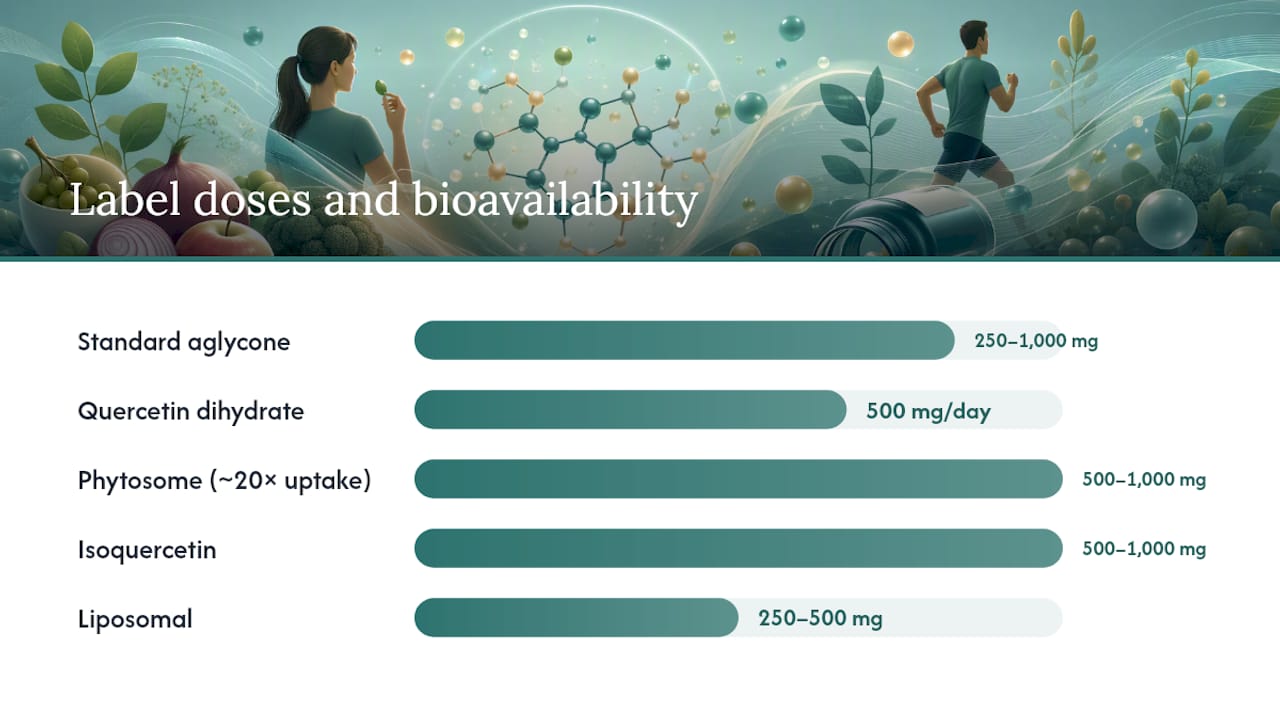
| Formulation | Dose range in studies | Relative bioavailability | Duration studied | Safety/monitoring notes |
|---|---|---|---|---|
| Standard aglycone | 250–1,000 mg/day | Reference (low, variable) | Days to 12 months | Well characterised; VKM anchor at 500 mg/day |
| Quercetin dihydrate | 500 mg/day | Similar to aglycone | At least 3 months | VKM safety anchor applies directly |
| Quercetin Phytosome® | 500–1,000 mg/day (label) | Markedly higher (up to ~20×) | 30 days (pilot) | Lower label dose achieves higher exposure; monitor accordingly |
| Isoquercetin | 500–1,000 mg/day | Higher than aglycone | Weeks to months | Less regulatory data; use with caution above 500 mg |
| Liposomal | 250–500 mg/day | Improved vs aglycone | Limited data | Emerging form; follow label guidance |
Pro Tip: When a label reads “Quercetin Phytosome®” or “phytosome”, the milligram figure does not compare directly with a standard quercetin product. A 250 mg phytosome dose may deliver more effective quercetin than 500 mg of the raw aglycone. Factor this in when choosing a dose.
Vivetus Quercetin uses a standardised quercetin formulation with a clear milligram-per-capsule declaration, making it straightforward to match the dose ranges discussed in this article. You can review the full Vivetus quercetin range to compare formats.
How and when should you take quercetin?
Timing matters less than consistency. Practitioners consistently note that daily adherence and taking quercetin with meals are the two most practical levers for measurable plasma accumulation, with morning versus evening timing having minimal documented impact on outcomes.
A practical daily routine
- Take quercetin with a meal that contains some fat. Fat aids absorption for most formulations, particularly the aglycone and phytosome forms.
- Split higher daily totals across two doses. Given the ~14–17 hour elimination half-life, splitting 500 mg into 250 mg twice daily both reduces peak-related gastrointestinal discomfort and maintains more stable plasma levels across the day.
- Consider pairing with vitamin C. Several clinical trials co-administer quercetin with vitamin C, and some with bromelain or zinc, on the basis of potential synergistic or absorption-supporting effects.
- Avoid taking quercetin at the same time as anticoagulant or antiplatelet medications without medical guidance.
- Stay consistent. Plasma accumulation builds over days to weeks; sporadic dosing produces unpredictable plasma levels.
Co-nutrients commonly paired with quercetin in trials include:
- Vitamin C: frequently co-administered; may support quercetin’s antioxidant activity.
- Bromelain: included in some commercial formulations to support absorption.
- Zinc: paired in several immune-focused protocols, though some RCTs excluded concurrent zinc supplementation to isolate quercetin’s effects.
Pro Tip: If you experience mild stomach discomfort, try taking quercetin mid-meal rather than before eating. This single adjustment resolves GI issues for most people without any dose reduction.
What are the side effects and drug interactions you should know?
Quercetin is generally well tolerated at maintenance doses. The most commonly reported side effects in clinical studies are mild gastrointestinal symptoms (nausea, stomach discomfort, loose stools) and occasional headache. Serious adverse events are rare in trials using doses up to 1,000 mg/day.
At very high doses, some studies have reported tolerability at 1,500 mg/day for 84 days and 5,000 mg/day for four weeks in small supervised studies, but these are not typical for unsupervised daily use and require clinical monitoring.
Drug interactions checklist
- Anticoagulants (warfarin, acenocoumarol): quercetin may inhibit CYP2C9, potentially increasing anticoagulant plasma levels. Do not combine without INR monitoring and clinician oversight.
- Antiplatelet agents (aspirin, clopidogrel): additive effects on platelet aggregation are theoretically possible; seek medical advice.
- CYP3A4 substrates: quercetin may inhibit CYP3A4 and P-glycoprotein, affecting the metabolism of a range of drugs including some statins, immunosuppressants, and calcium channel blockers.
- Thyroid medications: some evidence suggests quercetin may interfere with thyroid hormone uptake; consult a clinician if you take levothyroxine.
- Chemotherapy: quercetin has been studied as an adjunct in oncology settings, but interactions with cytotoxic agents are complex; always involve an oncologist.
For doses above 1,000 mg/day sustained over weeks, periodic liver function tests (ALT, AST) and kidney function checks (creatinine, eGFR) are advisable. This applies particularly to people with pre-existing organ conditions or those taking multiple medications.
Special populations: quercetin supplements are not recommended during pregnancy or breastfeeding. There is insufficient safety data for children; paediatric use should only occur under medical supervision.
What dosing plan fits your goal?
The right dose depends on what you are trying to achieve and how long you plan to supplement.
Dosing plans by goal
-
Daily maintenance (antioxidant and general healthy ageing support): 250–500 mg/day, taken with meals, indefinitely or for at least three months. This range aligns with the VKM safety anchor and the dose range used in most antioxidant and inflammation trials. No specialist monitoring is required at this level for healthy adults.
-
Short therapeutic course (cardiovascular, metabolic, or immune support): 500–1,000 mg/day for 4–12 weeks, as used in the majority of clinical RCTs. Splitting the dose (e.g. 500 mg twice daily) improves tolerability. A brief check-in with a clinician is sensible before starting, particularly if you are on other supplements or medications.
-
Higher/experimental protocols (senolytic or acute clinical use): up to 2,000 mg/day for short courses (days to a few weeks), used in some supervised clinical settings. These doses are outside the conservative safety range for unsupervised use. Liver and kidney monitoring is required.
| Goal | Dose range | Typical duration | Monitoring |
|---|---|---|---|
| Daily maintenance | 250–500 mg/day | 3 months or ongoing | None required for healthy adults |
| Therapeutic course | 500–1,000 mg/day | 4–12 weeks | Clinician check-in; monitor for GI symptoms |
| Experimental/clinical | Up to 2,000 mg/day | Days to a few weeks | Liver and kidney function tests; clinician supervision |
Pro Tip: Start at the lower end of your target range for the first two weeks. This allows your digestive system to adjust and gives you a clear baseline before increasing the dose.
How to choose a quercetin product that matches the evidence
Not all quercetin supplements are equivalent. The label milligram figure alone tells you little without knowing the formulation, standardisation, and testing status of the product.
Product selection checklist
- Standardised quercetin content per capsule: the label should state the exact milligrams of quercetin (not just the weight of an extract) so you can match the dose to the ranges discussed in this article.
- Formulation clearly stated: look for one of the recognised forms: quercetin aglycone, quercetin dihydrate, Quercetin Phytosome® (Quevir), isoquercetin, or liposomal quercetin. A label that simply says “quercetin extract” without specifying the form gives you no basis for dose comparison.
- Third-party purity testing: certificates of analysis from an independent laboratory confirm the product contains what it claims and is free from heavy metals and contaminants.
- Clear dosing instructions: a reliable product states the recommended daily dose, the number of capsules per serving, and any relevant timing guidance.
- No proprietary blends that obscure individual doses: if quercetin is listed in a blend without its own milligram figure, you cannot assess whether the dose is meaningful.
Vivetus Quercetin (500 mg per capsule) meets these criteria directly. Each capsule delivers a standardised 500 mg dose, placing it squarely within the maintenance-to-therapeutic range supported by clinical evidence. The product is vegan, purity-tested, and available with clear label dosing instructions. For those who want quercetin alongside complementary compounds, the Vivetus quercetin collection includes options suited to different supplementation goals.
When you see “Quercetin Phytosome®” on a label, that refers specifically to Indena’s patented phytosome technology (also marketed as Quevir). This is a distinct, enhanced-absorption product. A 500 mg Quercetin Phytosome® dose is not the same as 500 mg of standard quercetin dihydrate; the phytosome delivers a higher effective quercetin exposure per milligram of label dose.
Why conservative dosing is the right starting point
The gap between what quercetin can do at high doses in supervised trials and what is appropriate for unsupervised daily use is wider than most supplement guides acknowledge.
The plasma data is clear: 500 mg/day produces a substantial and measurable rise in fasting plasma quercetin. For most healthy adults pursuing general healthy ageing goals, that trade-off does not favour the higher dose.
There is also a practical argument for moderation. Quercetin’s half-life of 14–17 hours means that consistent daily dosing at 250–500 mg accumulates steadily in plasma. Chasing higher doses for faster results misreads the pharmacokinetics. The compound rewards adherence, not escalation.
Vivetus’s approach to quercetin reflects this: a standardised 500 mg capsule that sits at the upper end of the conservative maintenance range, backed by purity testing, with no pressure to exceed the evidence-supported dose. That alignment between the clinical evidence and the product design is what makes it a sensible choice for long-term supplementation.
Vivetus Quercetin: a straightforward option for Central Europe
Quercetin supplementation at the maintenance level is simple when the product is designed around the evidence. Vivetus Quercetin delivers 500 mg of standardised quercetin per capsule, matching the dose used in the large 12-week plasma trial and sitting precisely at the VKM’s conservative safety threshold for adults.
One capsule daily with a meal covers the maintenance range. For those who prefer a split-dose approach (250 mg twice daily), the capsule format makes that straightforward. Vivetus ships across Central Europe with free delivery on orders over €50, and both one-time purchase and subscription options are available, with subscriptions offering a lower per-unit cost for long-term users.
For readers who want quercetin paired with complementary compounds such as vitamin C or resveratrol, the Energy & Vitality bundle combines several of Vivetus’s longevity supplements in a single order. Customer support is available for dosing queries before purchase.
Visit the Vivetus Quercetin product page to check current availability and subscription pricing.
Primary sources and further reading
The following sources underpin the dosing figures, safety guidance, and formulation data in this article. Clinicians and technically curious readers are encouraged to consult the primary literature directly for clinical decision-making.
- Daily Quercetin Supplementation Dose-Dependently Increases Plasma Quercetin Concentrations in Healthy Humans (European Journal of Clinical Nutrition) — 12-week RCT (N=1,002) reporting plasma increases of ~332 μg/l at 500 mg/day and ~516 μg/l at 1,000 mg/day; primary source for the dose-plasma relationship data.
- Daily quercetin supplementation dose-dependently increases plasma quercetin concentrations in healthy humans (ScienceDirect) — two-week pharmacokinetic study reporting 178–570% plasma increases at 50–150 mg/day; source for half-life (~14–17 hours) and Tmax data.
- Rutin and quercetin: health risks of intake of food supplements (VKM) — Norwegian Scientific Committee risk assessment; primary source for the 500 mg quercetin dihydrate safety anchor for adults over at least three months.
- Quercetin: application in therapy and current clinical studies (Klinisch Onderzoek) — systematic summary of clinical dose ranges (250–2,000 mg/day) and study durations across indications.
- Prospective, randomised, controlled study of Quercetin Phytosome® as adjuvant in COVID-19 outpatients (Dovepress) — 30-day pilot RCT using 2 × 500 mg/day Quercetin Phytosome® (delivering ~400 mg quercetin); source for phytosome tolerability and clinical endpoint data.
Sources
- Daily Quercetin Supplementation Dose-Dependently Increases Plasma Quercetin Concentrations in Healthy Humans 1 2
- Daily quercetin supplementation dose-dependently increases plasma quercetin concentrations in healthy humans
- Rutin and quercetin — health risks of intake of food supplements (VKM)
- Quercetin – Toepassing in therapie en actuele klinische onderzoeken
- Prospective, randomised, controlled study of Quercetin Phytosome® as adjuvant in COVID‑19 outpatients (Dovepress — study download)